



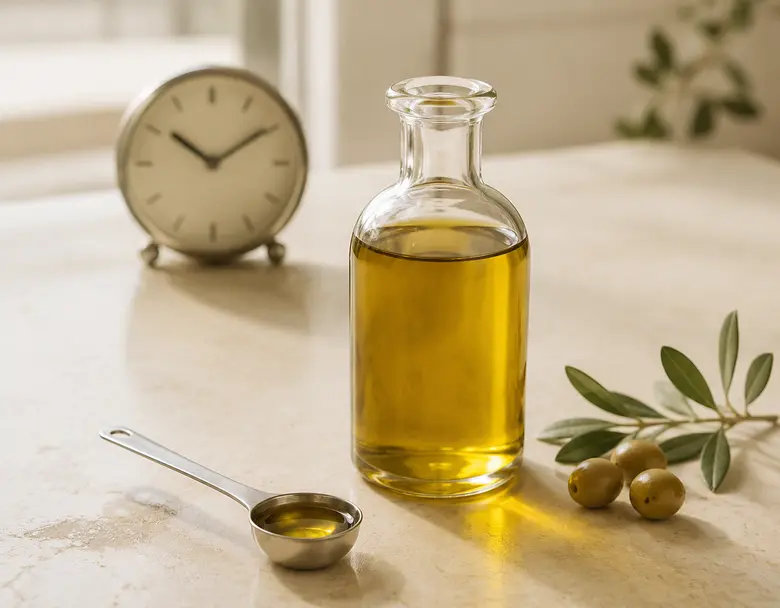
Yes, olive oil breaks a clean or calorie-free fast because it contains calories and fat. It does not contain carbohydrates or protein, but it is still food energy. If your fasting goal is strictly no calories, save olive oil for your eating window.
Key takeaways
- Olive oil contains calories, so it breaks a calorie-free fasting window.
- It is pure fat, not carbohydrate or protein, but fat still provides energy.
- A tiny amount may not matter for every person's goal, but it is not a clean-fast choice.
- Olive oil can fit well during the eating window or in a first meal after fasting.
- Do not turn olive oil into a loophole for fasting results.
Table of Contents
Why olive oil breaks a calorie-free fast
The FDA defines calories as the energy you get from carbohydrate, fat, protein, and alcohol in a food or drink [1]. Olive oil is almost entirely fat, and fat provides calories.
USDA FoodData Central lists olive oil at about 884 calories per 100 grams, with 100 grams of fat and 0 grams of carbohydrate or protein [2]. A typical tablespoon is much smaller than 100 grams, but it still contains meaningful calories.
That makes the practical answer clear: if your fasting rule is "no calories," olive oil breaks the fast.
For the broader rule, what breaks an intermittent fast can help you compare foods, drinks, and gray areas.
Why fat still counts
Some people assume olive oil does not break a fast because it has no sugar or carbs. But fasting is not only about carbohydrates.
If your goal is a clean fast, calories from fat still count. Olive oil may have a smaller immediate blood sugar effect than sugar, but it still gives your body energy from food. That means it does not belong in a strict fasting window.
If your question is specifically about how many calories matter, how many calories break intermittent fasting is the better next step.
When olive oil may still fit your routine
Olive oil can be a useful food during the eating window. It can make vegetables, salads, eggs, fish, beans, or whole-grain meals more satisfying.
The key is placement. Use olive oil as part of a meal, not as a fasting-window workaround.
Good uses during the eating window include:
- salad dressing
- cooking vegetables
- adding flavor to beans or whole grains
- finishing fish or lean protein
- pairing with a balanced first meal after fasting
If you are planning the first meal after fasting, how to break a fast safely can help you ease back into eating without overdoing it.
What about a teaspoon of olive oil?
A teaspoon is less than a tablespoon, but it still contains calories. If your fasting goal is strict, it breaks the fast.
If your fasting approach is flexible and your clinician has not given you strict fasting rules, a small amount may not matter much to your overall routine. But it should be counted honestly as food energy, not treated as zero.
Does olive oil help you stay in ketosis?
Olive oil is fat, so it may fit some low-carb or ketogenic eating windows. But that does not make it a fasting food.
Ketosis can occur during fasting or very low carbohydrate intake, but ketosis should not be treated as proof that a choice is healthier or better for every person [3]. If your goal is clean fasting, olive oil still breaks the fast.
How to keep the fasting window simple
During the fasting window, the simplest choices are:
- water
- black coffee
- unsweetened tea
Johns Hopkins lists water and zero-calorie beverages such as black coffee and tea as fasting-window options [4].
For more fasting-window drink choices, water and intermittent fasting can help you avoid accidental calories.
FAQ
Does fat break a fast?
For a clean or calorie-free fast, yes. Fat provides calories, even when it does not contain carbohydrates.
Does olive oil break autophagy?
Autophagy is complex and not something a blog article can measure for an individual. If your goal depends on strict fasting biology, avoid calories during the fasting window.
Is olive oil good to break a fast with?
It can be part of a balanced first meal, but avoid taking a large amount of oil by itself. A gentle meal with protein, fiber-rich plants, and a modest amount of fat is usually easier to tolerate.
Bottom line
Olive oil breaks a clean or calorie-free fast because it contains calories from fat. It can still fit well in the eating window, especially as part of a balanced meal. Keep the fasting window simple, and avoid treating oil as a no-calorie exception.
Medical disclaimer
This article is for general educational purposes only and is not medical advice. If you are fasting for a medical reason, have diabetes or blood sugar concerns, take medication, are pregnant or breastfeeding, or have a history of eating disorders, ask a qualified healthcare professional how fasting rules apply to you.
References
- FDA. "Calories on the Nutrition Facts Label." https://www.fda.gov/food/nutrition-facts-label/calories-nutrition-facts-label
- USDA FoodData Central. "Oil, olive, salad or cooking." https://fdc.nal.usda.gov/fdc-app.html#/food-details/171413/nutrients
- Harvard T.H. Chan School of Public Health, The Nutrition Source. "Diet Review: Ketogenic Diet for Weight Loss." https://nutritionsource.hsph.harvard.edu/healthy-weight/diet-reviews/ketogenic-diet/
- Johns Hopkins Medicine. "Intermittent Fasting: What Is It, And How Does It Work?" https://www.hopkinsmedicine.org/health/wellness-and-prevention/intermittent-fasting-what-is-it-and-how-does-it-work