



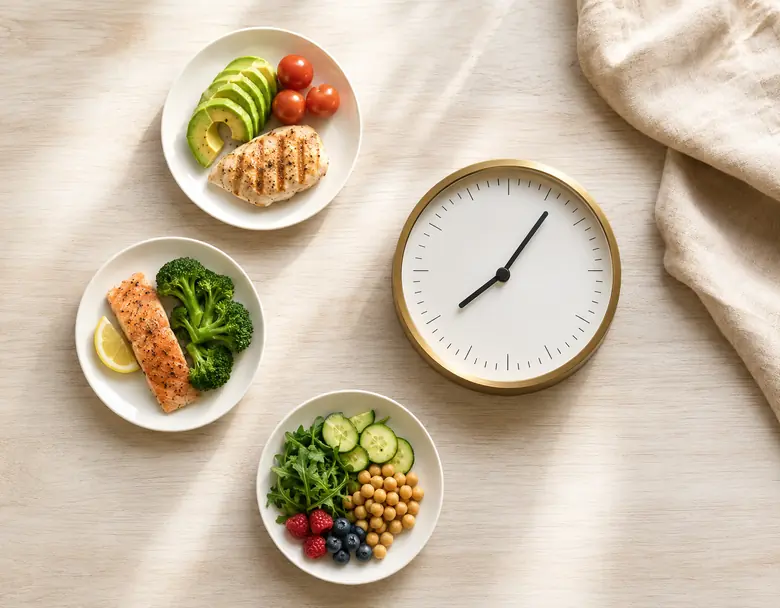
An intermittent fasting window is the time you choose for eating and fasting. A 14:10 schedule means a 10-hour eating window and a 14-hour fast; 16:8 means an 8-hour eating window and a 16-hour fast. The right window should fit your meals, health context, sleep, work, and consistency, not just sound strict.[1][2]
Key takeaways
- A shorter eating window is not automatically better.
- Many beginners do better with 12:12 or 14:10 before trying 16:8.[2]
- The eating window still needs balanced meals and enough fluids.
- Longer fasts are not automatically better and may be dangerous for some people.[1]
- GoFasting can help you log fasting windows and review patterns as you adjust your routine.
Table of Contents
Common intermittent fasting windows
| Schedule | Fasting window | Eating window | Practical fit |
|---|---|---|---|
| 12:12 | 12 hours | 12 hours | Gentle start, late-night snack reduction |
| 14:10 | 14 hours | 10 hours | Beginner structure without a harsh cut |
| 16:8 | 16 hours | 8 hours | Better after shorter windows feel steady |
| 18:6 | 18 hours | 6 hours | More restrictive; not a default start |
| 20:4 | 20 hours | 4 hours | Very restrictive; higher rebound risk |
For most beginners, the most useful window is the one that creates structure without making meals feel rushed or triggering overeating.
How to choose your eating window
Start with your real life. A window that includes normal meals is better than one that requires constant exceptions.
| Your pattern | Try first | Reason |
|---|---|---|
| Late-night snacking | 12:12 | Gives a clear evening cutoff |
| All-day grazing | 14:10 | Adds structure without a very short window |
| Breakfast is easy to delay | 14:10 or 16:8 | Builds on an existing habit |
| Family dinner is important | Later 10-hour window | Protects social consistency |
| You overeat after restriction | 12:12 | Reduces rebound risk |
| Medication requires food | Clinician-guided timing | Meal timing may affect safety |
If your main goal is weight loss, choose the window that reduces extra eating without creating compensation. Intermittent fasting may help some people reduce eating opportunities, but timing alone is not the whole plan.[3]
Can you eat fruit during the eating window?
Yes. Fruit belongs in the eating window and can be part of a balanced meal pattern. Fruits provide fiber and nutrients, and they can be more filling than many sweet snacks. Pairing fruit with protein or healthy fats, such as yogurt, nuts, eggs, or tofu, can make the meal more satisfying.
Fruit juice is different from whole fruit. Juice is easier to drink quickly and is less filling, so it is better treated as a limited choice rather than a default fasting routine beverage.[4]
How to start testing a fasting window
Use a two-week test:
- Start with 12:12 or 14:10 if you are new.
- Choose a window that fits your usual meals.
- Keep fasting-window drinks simple: water, black coffee, or unsweetened tea.[1]
- Eat balanced meals during the eating window.
- Keep weekends close enough that you do not restart every Monday.
- Review hunger, sleep, mood, digestion, weight trend, and consistency.
GoFasting can help you compare fasting windows and review whether the routine is becoming easier to repeat. Tracking can make the experiment clearer, but it does not decide whether fasting is medically appropriate.
When to adjust the window
Shorten or shift your window if you feel dizzy, faint, unusually weak, unable to sleep, or likely to overeat when the window opens. If the schedule causes food anxiety or binge-restrict cycles, stop the experiment and seek qualified support.[5]
People who are pregnant or breastfeeding, under 18, have diabetes or blood-sugar concerns, take medications that require food, have a history of eating disorders, or have a medical condition should get guidance before fasting.[1][6]
FAQ
What is an intermittent fasting window?
It is the period of time you fast and the period of time you eat. In 14:10, you fast for 14 hours and eat within 10 hours.
What is a good intermittent fasting window?
For many beginners, 12:12 or 14:10 is a good starting point because it adds structure without being too restrictive.
Is 16:8 better than 14:10?
Not always. 16:8 is stricter. 14:10 may be better if it supports balanced meals and consistency.
Can I eat fruits during an intermittent fasting window?
Fruit can fit during the eating window. Keep calorie-containing foods and drinks out of the fasting window if your goal is a clean fast.
Do eating windows have to be fixed every day?
They do not have to be identical, but a consistent pattern makes the routine easier to evaluate.
Can i eat fruits during intermittent fasting window?
The answer depends on your fasting window, eating-window habits, health context, and whether the routine is repeatable. Use the guidance above as a starting point, and get qualified advice if medical conditions, medications, pregnancy, breastfeeding, underweight status, or eating-disorder risk apply.
Bottom line
Choose an intermittent fasting window by fit, not intensity. Start gently, protect balanced meals, review your pattern after two weeks, and avoid making the fast longer just because progress feels slow.
Medical disclaimer
This article is for general wellness education and should not replace medical advice. Speak with a qualified health care professional before fasting if you are pregnant or breastfeeding, under 18, have diabetes or blood-sugar concerns, take medications that require food, have a history of eating disorders, have a medical condition, or feel unwell while fasting.
References
- Johns Hopkins Medicine. “Intermittent Fasting: What Is It, And How Does It Work?” https://www.hopkinsmedicine.org/health/expert-qa/intermittent-fasting-what-is-it-and-how-does-it-work
- Cleveland Clinic. “Intermittent Fasting: What It Is, Benefits and Schedules.” https://health.clevelandclinic.org/intermittent-fasting-4-different-types-explained
- Lowe DA, Wu N, Rohdin-Bibby L, et al. “Effect of Time-Restricted Eating on Weight Loss in Adults With Overweight and Obesity.” JAMA Internal Medicine https://jamanetwork.com/journals/jamainternalmedicine/fullarticle/2771095
- Harvard T.H. Chan School of Public Health. “Healthy Drinks.” https://nutritionsource.hsph.harvard.edu/healthy-drinks/
- National Institute of Mental Health. “Eating Disorders.” https://www.nimh.nih.gov/health/topics/eating-disorders
- Harvard T.H. Chan School of Public Health. “Diet Review: Intermittent Fasting for Weight Loss.” https://nutritionsource.hsph.harvard.edu/healthy-weight/diet-reviews/intermittent-fasting/