



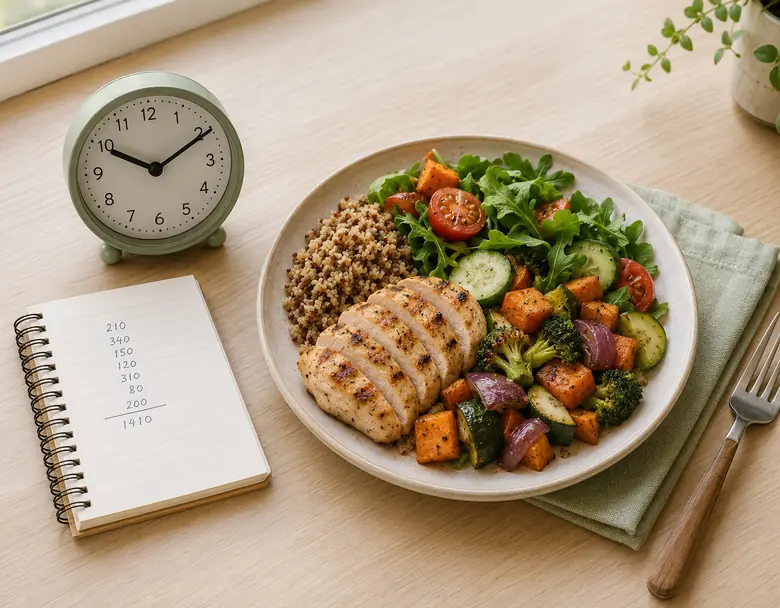
Intermittent fasting changes when you eat. Calorie counting tracks how much energy you eat and drink. Neither approach is automatically better for weight loss. The better choice is the one that helps you create a realistic, nourishing, repeatable pattern without triggering stress, unsafe restriction, or medication problems.[1][2]
Key takeaways
- Intermittent fasting may reduce eating opportunities, but it does not guarantee a calorie deficit.[3]
- Calorie counting can make intake more visible, but it is not required for everyone and can feel stressful for some people.
- Research does not show intermittent fasting is clearly superior to traditional dietary advice for adults with overweight or obesity.[1]
- If you have diabetes, take medication affected by meals, are pregnant or breastfeeding, are underweight, or have eating-disorder history, get medical guidance before using either approach for weight loss.[4][5]
Table of Contents
How intermittent fasting and calorie counting differ
| Question | Intermittent fasting | Calorie counting |
|---|---|---|
| Main focus | When you eat | How much energy you eat and drink |
| Common advantage | Simple meal timing rules | Clearer picture of portions and drinks |
| Common challenge | Eating-window overeating can erase the deficit | Numbers can become tedious or stressful |
| Likely fit | People who like routine boundaries | People who want more intake visibility |
| Main risk | Making the window too restrictive | Turning food into constant math |
A calorie deficit means your body uses more calories than you take in over time. Intermittent fasting may help some people create that pattern by reducing eating opportunities, but the fasting window does not guarantee it.[3]
Is intermittent fasting better for weight loss?
Not automatically. Intermittent fasting can be useful if it helps you skip mindless snacking, simplify meals, or reduce late-night eating. But studies comparing intermittent fasting with traditional dietary advice do not support calling it clearly superior for weight loss.[1]
The practical takeaway is simple: fasting can be one structure, not a shortcut. Food quality, portions, activity, sleep, stress, and long-term consistency still matter.[2][6]
When calorie counting may be more helpful
Calorie counting may help if you are unsure where intake is coming from, drink calories often, eat many packaged foods, or have a plateau that might be related to portions. It can also be useful as a short-term learning tool rather than a forever rule.
It may not be a good fit if it increases anxiety, rigid food rules, guilt, or binge-restrict cycles. If eating feels out of control or distressing, focus on support rather than stricter rules.[5][7]
Can you combine fasting and calorie counting?
Yes, but keep it light. You do not need to turn intermittent fasting into a full-time numbers project. A useful middle ground is to log a few representative eating-window days to check portions, protein, fiber, snacks, and drinks.
GoFasting can help you log fasting windows, weight, steps, calorie intake, and water intake, then review patterns as you adjust your routine. Use tracking as feedback, not judgment.
What about intermittent fasting vs low carb?
Low carb changes what you eat; intermittent fasting changes when you eat. Combining both can become restrictive quickly, especially if you cut carbohydrates sharply while also narrowing the eating window. Sudden or severe carbohydrate restriction can cause symptoms such as constipation, headaches, tiredness, weakness, and flu-like symptoms, and people with diabetes, heart disease, kidney disease, or other health conditions should check with a health care professional before starting a weight-loss diet.[8]
FAQ
Is intermittent fasting better than calorie counting?
No single approach is better for everyone. Intermittent fasting may feel simpler, while calorie counting may offer more precision. The better choice is the one you can repeat safely.
Can I lose weight with fasting without counting calories?
Some people can, especially if fasting naturally reduces eating opportunities. But weight loss still depends on the overall balance between intake and energy use.[3]
Is calorie counting healthier than fasting?
Not automatically. Either approach can be done reasonably or too restrictively. Nutrition quality and safety matter more than the label.
Bottom line
Intermittent fasting and calorie counting are tools, not moral tests. If fasting gives you structure, use it gently. If calorie tracking gives you clarity, use it lightly. If either one makes food feel unsafe, obsessive, or out of control, step back and get support.
Medical disclaimer
This article is for general education only and is not medical advice. Ask a qualified health professional before changing your eating pattern if you have medical conditions, take medication, are pregnant or breastfeeding, are underweight, or have eating-disorder history.
References
- Cochrane. Intermittent fasting for adults with overweight or obesity https://www.cochrane.org/evidence/CD015610_intermittent-fasting-traditional-dietary-advice-or-no-treatment-which-works-better-help-adults
- NIDDK. Choosing a Safe & Successful Weight-loss Program https://www.niddk.nih.gov/health-information/weight-management/choosing-a-safe-successful-weight-loss-program
- CDC. Physical Activity and Your Weight and Health https://www.cdc.gov/healthy-weight-growth/physical-activity/
- Harvard T.H. Chan School of Public Health. Diet Review: Intermittent Fasting for Weight Loss https://nutritionsource.hsph.harvard.edu/healthy-weight/diet-reviews/intermittent-fasting/
- National Institute of Mental Health. Eating Disorders https://www.nimh.nih.gov/health/topics/eating-disorders
- CDC. Steps for Losing Weight https://www.cdc.gov/healthy-weight-growth/losing-weight/index.html
- American Heart Association. Why Do I Eat When I'm Not Hungry? https://www.heart.org/en/healthy-living/healthy-eating/losing-weight/eating-when-not-hungry
- Mayo Clinic. Low-carb diet: Can it help you lose weight? https://www.mayoclinic.org/healthy-lifestyle/weight-loss/in-depth/low-carb-diet/art-20045831