


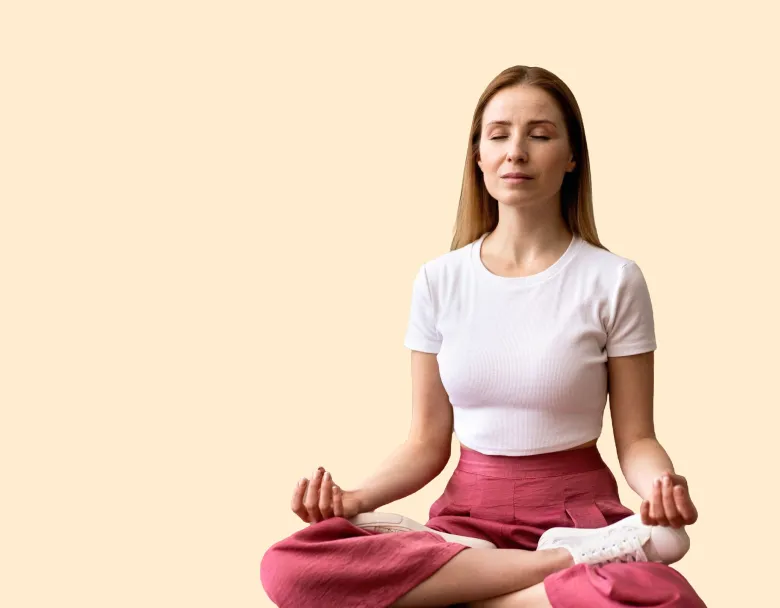
Meditation is often described as a way to erase anxiety, heal trauma, or fix every stressful day. The evidence supports a more modest and more useful picture. Mindfulness meditation may help some people manage stress and symptoms of anxiety or low mood, and it may offer smaller or less certain benefits for sleep and blood pressure.[1][2]
It is not a cure, it does not work the same way for everyone, and it is not a replacement for professional care. This guide explains what the evidence supports, what it does not establish, and how to try a short practice without treating it as a test of willpower.
Key takeaways
- Mindfulness meditation programs have moderate evidence of small-to-moderate improvements in anxiety and depression symptoms for some people.[1][2]
- Sleep and blood-pressure findings are more limited and do not make meditation a treatment for insomnia or hypertension.[1]
- Meditation can support a stress-management routine, but it cannot diagnose, cure, or replace care for a mental-health condition.
- A minority of people report unwanted effects, including increased anxiety or depression. Stop a practice that consistently makes you feel worse and seek appropriate support.[1]
- A short practice is optional. You do not need to meditate to fast successfully or to prove that you are handling hunger well.
Table of Contents
What the evidence supports most clearly
Meditation is a broad term. Much of the health research discussed here concerns mindfulness-based programs, which usually combine guided practice with ways to notice thoughts, feelings, and physical sensations without immediately reacting to them.
A systematic review of 47 trials involving more than 3,500 participants found small-to-moderate improvements in anxiety, depression, and pain when mindfulness meditation programs were compared with no treatment.[2] That is meaningful for some people, but it does not mean meditation is better than established care or that it will help every person in the same way.
The National Center for Complementary and Integrative Health also describes mixed results across types of meditation, populations, and study designs. That uncertainty is worth keeping in view: a practice can be reasonable to try without being a guaranteed solution.[1]
| Common claim | What the evidence supports | A useful boundary |
|---|---|---|
| “Meditation reduces stress” | It may help some people notice stress and respond with less reactivity.[1][2] | It does not remove every source of stress. |
| “Meditation treats anxiety or depression” | It may support symptom management for some people.[1][2] | It is not a substitute for assessment or treatment. |
| “Meditation fixes sleep” | Some people with sleep disturbance may notice better sleep quality.[1] | Persistent insomnia needs a broader assessment and plan. |
| “Meditation lowers blood pressure” | Some reviews report modest changes in some groups.[1] | It is not a treatment for hypertension. |
| “Meditation heals trauma” | This is not a claim the evidence can support. | Trauma-informed professional care remains important. |
How meditation may help in everyday life
Meditation does not make difficult emotions disappear. Its practical value may be creating a small pause between noticing a feeling and acting on it. That pause can be useful when you are tense, distracted, or caught in an automatic routine.
For example, a person may notice that they are stressed before they automatically open a snack, send an impulsive message, or keep scrolling late at night. Meditation is not the only way to create that pause. If a structured practice is not for you, Breathing Techniques for Stress Relief and Focus offers another short, practical option. For a broader approach that does not turn stress management into another demanding task, see How to Manage Stress Without Turning It Into Another Task.
Sleep: one option, not the whole answer
Mindfulness may help some people with sleep quality, but it is not clearly better than established options such as cognitive behavioral therapy for insomnia or exercise.[1] If sleep trouble continues, look beyond a single practice: regular routines, light exposure, caffeine timing, stress, and medical factors can matter. Tips for Improving Sleep: A Practical Night and Day Routine covers those broader habits.
What research cannot establish
Brain-imaging findings are sometimes used to make meditation sound more certain than it is. One 2011 controlled study found changes in gray-matter concentration after an eight-week mindfulness-based stress-reduction program.[3] It is an interesting finding about how the brain may adapt with practice. It does not show that meditation permanently rewires someone, heals trauma, or treats a mental-health condition.
The practical standard is simpler: assess whether a gentle practice helps you feel more settled or supported in daily life. Do not use a neuroscience headline as a promise of a health outcome.
When meditation is not the right tool to push through
Meditation is a self-help practice, not a requirement to endure distress. Do not use it to postpone professional care for anxiety, depression, PTSD, or another mental-health condition.[1]
Some people experience unwanted effects from meditation. A review of 83 studies found that about 8% of participants reported a negative effect, most often anxiety or depression, although reporting and study quality varied.[1] Stop or change the practice if it repeatedly leaves you more anxious, panicky, dissociated, or low. Consider a gentler grounding activity and speak with a qualified professional when needed.
Get prompt professional help if symptoms are severe, persistent, interfere with daily life, or involve thoughts of self-harm. In an immediate crisis, contact local emergency services or a crisis resource.
A short, low-pressure way to begin
You do not need an app, special equipment, or a spiritual framework to try meditation.
- Choose a reasonably quiet place and set a timer for three to five minutes.
- Keep your attention on a neutral anchor, such as normal breathing, sounds in the room, or the sensation of your feet on the floor.
- When your mind wanders, notice it and return to the anchor without treating it as a mistake.
- If closing your eyes or focusing on breathing feels uncomfortable, keep your eyes open and use what you can see, hear, and feel around you instead.
- Stop if the practice makes you feel worse. A different approach—or no meditation practice at all—can be the right choice.
Try a brief practice on ordinary days, not only when you are already overwhelmed. The goal is to learn whether it is useful for you, not to achieve a particular state of mind.
Using a mindful pause around fasting
During intermittent fasting, a short pause may help you tell the difference between a passing urge, stress, boredom, and a need that deserves attention. It should never be used to override genuine hunger, dizziness, weakness, or other symptoms that feel unsafe.
If hunger is manageable and you want practical ways to plan for it, see How to Reduce Hunger While Fasting. If you feel dizzy or unwell, follow the safer next steps in What to Do About Dizziness While Fasting rather than trying to meditate through it. If sleep is becoming lighter during fasting, Why Fasting Can Cause Light Sleep may help you review the pattern.
How GoFasting fits in
GoFasting is a fasting app, not a meditation or mental-health tracker. It cannot measure your stress, tell you whether meditation is helping, or determine whether fasting is medically appropriate. If you choose to use a brief practice alongside fasting, you can use fasting records as one way to notice whether your routine feels sustainable over time. That is personal observation, not a health claim made by the app.
FAQ
What is the most reliable benefit of meditation?
Mindfulness meditation programs have the clearest evidence for small-to-moderate improvements in anxiety and depression symptoms for some people. Results vary, and meditation is not a cure or a replacement for treatment.[1][2]
Can meditation cure anxiety or depression?
No. It may support some people alongside appropriate care, but it should not replace professional assessment or treatment when symptoms are significant.[1]
Can meditation help with sleep?
It may help some people with sleep quality. Treat it as one option rather than a complete solution, especially if sleep problems continue.[1]
Can meditation make you feel worse?
Yes. Some people report increased anxiety, depression, or other unwanted effects. Stop a practice that consistently makes you feel worse and seek professional support when needed.[1]
Do I need meditation to fast successfully?
No. Meditation is optional. It can be a brief awareness practice for some people, but it should never be used to ignore hunger, dizziness, weakness, or other symptoms that need attention.
Medical disclaimer
This article is for educational purposes only and is not medical advice. Meditation is not a treatment for or substitute for professional care of anxiety, depression, PTSD, or any mental-health condition. Speak with a qualified healthcare or mental-health professional if you have a psychiatric or trauma history, severe or persistent symptoms, or are unsure whether a practice is appropriate for you. If you have thoughts of harming yourself, contact local emergency services or a crisis resource right away.
References
- National Center for Complementary and Integrative Health. Meditation and Mindfulness: Effectiveness and Safety. Accessed July 8, 2026.
- Goyal M, Singh S, Sibinga EMS, et al. Meditation programs for psychological stress and well-being: a systematic review and meta-analysis. JAMA Internal Medicine. 2014;174(3):357-368.
- Hölzel BK, Carmody J, Vangel M, et al. Mindfulness practice leads to increases in regional brain gray matter density. Psychiatry Research: Neuroimaging. 2011;191(1):36-43.