



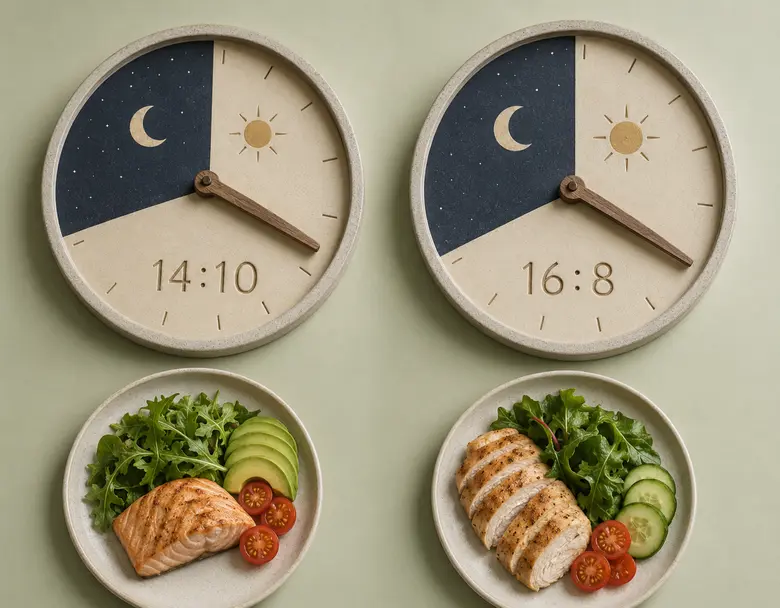
For most beginners, 14/10 is the gentler place to start. 16/8 can work for some people, but the extra two fasting hours are not automatically better. The better choice is the schedule that lets you eat balanced meals, function normally, and stay consistent without symptoms or medication problems.[1][2]
Key takeaways
- 14/10 means fasting for 14 hours and eating during a 10-hour window.
- 16/8 means fasting for 16 hours and eating during an 8-hour window.
- 14/10 usually leaves more room for meals, social life, and gradual adaptation.
- 16/8 may fit people who already tolerate shorter fasts and can still meet nutrition needs.
Table of Contents
14/10 vs 16/8 at a glance
| Feature | 14/10 | 16/8 |
|---|---|---|
| Fasting window | 14 hours | 16 hours |
| Eating window | 10 hours | 8 hours |
| Beginner fit | Often easier | Better after shorter fasts feel steady |
| Meal flexibility | More room for 2-3 meals | More planning needed |
| Risk of over-restriction | Lower | Higher if meals become too compressed |
| Best use | First structured schedule | Next step after 14/10 if appropriate |
When 14/10 may be the better choice
Choose 14/10 if you are new to fasting, have a demanding schedule, prefer breakfast, train in the morning, have a history of over-restricting, or want a routine that feels less disruptive.
A 14/10 day might look like eating from 8 a.m. to 6 p.m. or 9 a.m. to 7 p.m. The goal is not perfection. It is to create a repeatable rhythm while still eating enough.
When 16/8 may be reasonable
16/8 may be reasonable if 14/10 already feels easy, you can eat balanced meals in eight hours, your energy and concentration stay normal, and no medication or medical issue makes longer fasting risky.
A 16/8 day might look like eating from 10 a.m. to 6 p.m. or noon to 8 p.m. If it leads to dizziness, overeating, poor sleep, constipation, irritability, or obsession with food, return to a wider eating window.
How to move from 14/10 to 16/8
Do not jump just because 16/8 sounds more serious. Try this instead:
- Keep 14/10 steady for one to two weeks.
- Shift the eating window by 30 to 60 minutes, not several hours at once.
- Keep meals nutrient-dense and satisfying.
- Track whether the routine is easier to repeat, not just whether the fast is longer.
- Stop at 14/10 if it already supports your goal.
GoFasting can help you compare fasting windows and review whether your routine is becoming easier to repeat. Tracking supports consistency; it does not prove one schedule is medically better.
Who should be careful with either schedule
Ask a clinician before fasting if you have diabetes, take medications affected by food timing, are pregnant or breastfeeding, are underweight, have eating-disorder history, have kidney disease, or have a chronic condition.[3]
FAQ
Is 14/10 intermittent fasting as good as 16/8?
It can be the better fit if it is more sustainable and less disruptive. More fasting hours do not automatically mean better results.
Does 16/8 burn more fat than 14/10?
A longer fasting window may reduce eating opportunities, but weight and health outcomes depend on the whole pattern, including food quality and total intake.[4]
Should beginners start with 14/10 or 16/8?
Most beginners should start with 14/10 or even 12:12, then adjust only if the routine feels steady.
Bottom line
Start with 14/10 if you want a safer, more flexible first experiment. Consider 16/8 only if you can keep meals balanced, symptoms low, and the routine sustainable.
Medical disclaimer
This article is for general education only and is not medical advice. Ask a qualified clinician before fasting if you have a medical condition, take medication, are pregnant or breastfeeding, or have eating-disorder history.
References
- Cleveland Clinic. Intermittent Fasting: What It Is, Benefits and Schedules https://health.clevelandclinic.org/intermittent-fasting-4-different-types-explained
- Johns Hopkins Medicine. Intermittent Fasting: What Is It, And How Does It Work? https://www.hopkinsmedicine.org/health/expert-qa/intermittent-fasting-what-is-it-and-how-does-it-work
- Cleveland Clinic. 6 Tips for Fasting Safely https://health.clevelandclinic.org/tips-for-fasting-the-healthy-way
- Cochrane. Intermittent fasting for adults with overweight or obesity https://www.cochrane.org/evidence/CD015610_intermittent-fasting-traditional-dietary-advice-or-no-treatment-which-works-better-help-adults