

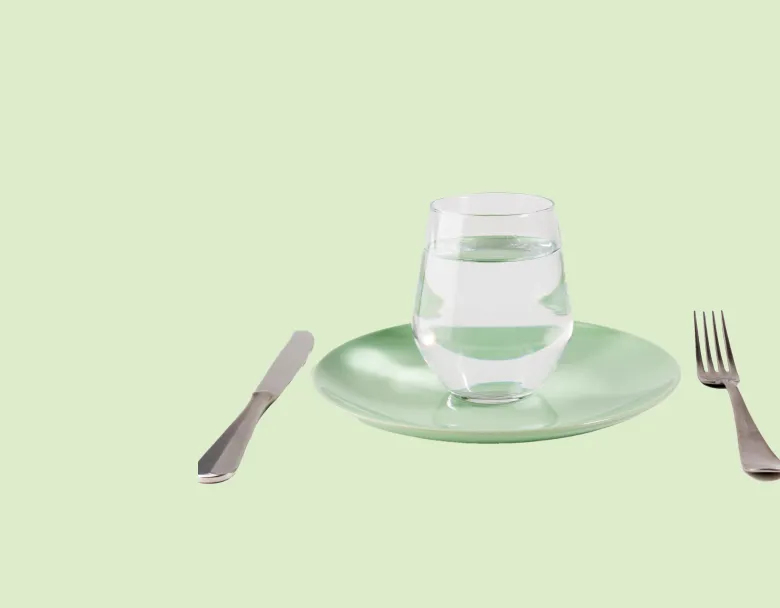
Water fasting means drinking only water and eating nothing, usually for anywhere from 24 hours to several days. It is one of the most extreme forms of fasting, because no food means no calories, protein, or electrolytes coming in. During a water fast your body first burns through its stored carbohydrate (glycogen), then shifts to breaking down fat for fuel. That shift is normal biology, not proof of a health benefit. The longer a fast runs, the more the safety questions matter, and some people should not water fast at all.
This article explains what water fasting is, how it differs from intermittent fasting, what actually happens inside your body, how long people typically attempt it and why longer means riskier, and who should avoid it or stop. It is educational and does not replace advice from your own doctor.
Key takeaways
- Water fasting means only water, no food, usually for 24 hours up to several days. It is different from intermittent fasting, where you still eat every day inside a set window.
- Your body switches from burning stored carbohydrate to burning fat and making ketones within roughly a day of fasting. This is a fuel switch, not a guaranteed health outcome. [1][2]
- Longer fasts carry more risk. Beyond a day or two, dehydration, low blood pressure, and electrolyte problems become more likely, and most multi-day fasts in research were done under medical supervision. [3][4]
- Some people should not water fast at all, including people who are pregnant or breastfeeding, have diabetes or take glucose-lowering medicine, have a current or past eating disorder, are under 18, or manage a chronic condition with medication. Check with a clinician first. [5]
- Stop and seek help for fainting, a racing or irregular heartbeat, confusion, or severe dizziness. These are not signs to push through. [3]
- Coming off a longer fast has its own risk, called refeeding syndrome, so how you break the fast matters as much as the fast itself. [6][7]
How is water fasting different from intermittent fasting?
People often use these terms as if they mean the same thing, but they don't, and the difference changes the risk.
With intermittent fasting, you still eat every day. You just concentrate your meals into a set window, for example eating within an eight-hour window and not eating for the other sixteen hours. Some approaches allow a small number of calories on "fasting" days rather than none at all. [2]
With water fasting, you eat nothing at all, only water, for a continuous stretch that usually runs from a full day to several days. No calories, no protein, no electrolytes, no fat come in during that time.
That is the key distinction. Intermittent fasting keeps daily nutrition coming in; water fasting removes it entirely for as long as the fast lasts. Because of that, the two are not interchangeable, and a longer water fast is a much bigger physiological ask than skipping breakfast.
What happens in your body during a water fast
Understanding the sequence helps you see why the first day feels different from the third, and why length changes the safety picture.
In the first several hours after your last meal, your body runs mostly on glucose from the food you ate and from glycogen, the stored form of carbohydrate in your liver and muscles. Liver glycogen is limited and is largely used up within roughly the first day of fasting.
Once that stored carbohydrate runs low, your body switches its main fuel source. It starts breaking down fat, and the liver turns part of that fat into molecules called ketones, which many tissues, including the brain, can use for energy. Researchers call this the "metabolic switch" from glucose to fat-derived fuel. [1] In studies of prolonged fasting, ketone levels rise steadily over the first days and plateau after about a week. [2]
It is worth being clear about what this switch does and does not mean. The shift to burning fat and making ketones is normal biology that happens in anyone who stops eating long enough. It is a description of how your body copes without food, not evidence that going without food is good for you. In fact, reviews of prolonged fasting found that a large share of the weight lost is lean tissue, not just fat, and that many of the short-term metabolic changes faded within a few months. [2] Treat the fuel switch as a mechanism to understand, not a benefit to chase.
How long do people water fast, and why does longer mean riskier?
There is no single "standard" length. In practice, people attempt water fasts ranging from a single 24-hour period up to multi-day fasts, and clinical studies of prolonged water-only fasting have run anywhere from about 5 to 20 days. [2] But the length is exactly where the risk lives, because your margin for error shrinks the longer you go.
A short fast of about a day is, for a healthy adult without contraindications, a smaller ask: your body is mostly drawing on stored fuel, and you are not yet deeply depleting fluids or electrolytes. As a fast extends into multiple days, several things stack up. You take in no sodium, potassium, or other electrolytes, so their balance can drift. Blood pressure can drop, which is why feeling faint on standing is one of the more common effects. [4] Fluid balance gets harder to hold steady. [3]
This is why the multi-day fasting studies in the research were almost all done under medical supervision, with monitoring, rather than at home. [3][4] The takeaway is not a specific "safe" number of days, but a direction: the longer you intend to fast, the stronger the case for medical guidance beforehand, and the less it is something to improvise alone.
When should you avoid water fasting, or talk to a clinician first?
Some people carry enough added risk that water fasting is not an appropriate thing to try on their own, and for some it should be avoided entirely. This is the part to sort out before you start, not partway through.
Talk to a clinician first, or avoid water fasting, if you:
- Are pregnant or breastfeeding. [5]
- Have diabetes or take insulin or other glucose-lowering medicine, because skipping all food can push blood sugar too low. [5]
- Have a current or past eating disorder, or a history of restrictive eating. Going without food can reactivate harmful patterns. [5]
- Are under 18 and still growing. [5]
- Take regular medication or manage a chronic condition, including kidney, heart, or liver conditions, or have low blood pressure. Fasting can change how medicines work and how your body handles fluid and electrolytes. [3][5]
If any of these apply to you, the safe next step is a conversation with your doctor or pharmacist about whether fasting is appropriate at all, rather than trying to adjust the length of a fast to make it fit. Some of these situations are reasons to avoid water fasting entirely, and no amount of shortening the fast makes them safe.
Warning signs to stop a water fast
Even for someone without those risk factors, a water fast can produce symptoms that mean stop now, not push through. Break the fast and, for the more serious signs, get medical help if you experience:
- Fainting, or feeling like you are about to faint.
- A racing, pounding, or irregular heartbeat (palpitations).
- Confusion, trouble thinking clearly, or feeling disoriented.
- Severe or persistent dizziness, especially on standing.
Mild hunger, some tiredness, or a headache are commonly reported during fasting. [2] But the signs above point to problems like a large blood pressure drop or an electrolyte disturbance, and they are reasons to eat and, if they are severe or don't settle quickly, to seek urgent care. Documented fasting programs have had rare but serious events, including severe dehydration and dangerously low blood sodium, which is exactly why these signals should not be ignored. [3]
Coming off a water fast: why refeeding matters
How you end a longer fast deserves as much attention as the fast itself. After the body has spent days without food, eating again, especially a large carbohydrate-heavy meal, can trigger a dangerous shift called refeeding syndrome.
When food returns, insulin rises and drives minerals like phosphate, potassium, and magnesium rapidly into your cells, dropping their levels in the blood. This can strain the heart and other organs and, in severe cases, is life-threatening. [6][7] The people most at risk are those who were most depleted, which is why longer fasts raise the concern.
The practical point: breaking a longer fast is not simply "start eating normally again." For anyone who has fasted for several days, reintroducing food gradually and, ideally, under medical guidance is part of doing it safely. This is another reason multi-day fasting sits in medically supervised territory rather than do-it-yourself territory.
How GoFasting fits once you have a plan
If you and your clinician have decided a fasting routine is appropriate for you, staying consistent with it day to day is easier when you can see it in one place. GoFasting can help you log your fasting window, water intake, weight, and steps, and review those patterns over time so your routine stays steady rather than guesswork. Separately, pay attention to hunger, energy, sleep, and how you feel, and treat those as your own observations to raise with your clinician, not something the app decides for you.
Keep an approved routine consistent
Once a clinician has confirmed a fasting plan suits you, use GoFasting to track the basics so your routine stays steady.
- Fasting window — See when your eating window opens.
- Water intake — Keep hydration on record.
- Weight — Review trends over time, not single days.
- Steps — Track daily movement.
FAQ
Is water fasting the same as intermittent fasting?
No. With intermittent fasting you still eat every day, just inside a set window. With water fasting you eat nothing at all, only water, for a continuous stretch that usually lasts from a day to several days. [2]
How long can you safely water fast?
There is no single safe number. A short fast of about a day is a smaller ask for a healthy adult, while multi-day fasts raise the risk of dehydration, low blood pressure, and electrolyte problems, and were mostly studied under medical supervision. The longer you plan to fast, the stronger the case for talking to a clinician first. [3][4]
Does water fasting burn fat?
Once your stored carbohydrate runs low, usually within about a day, your body does shift to burning fat and making ketones. But research found a large share of the weight lost during prolonged fasting is lean tissue, not only fat, so "burns fat" is an oversimplification. [1][2]
Can you drink coffee or tea on a water fast?
Strictly, a water fast means only water. Adding other drinks changes what you are doing. If your goal or plan allows other calorie-free drinks, that is a different approach and worth clarifying with whoever is guiding your plan.
Why do I feel dizzy or lightheaded while fasting?
Fasting can lower blood pressure and shift your fluid and electrolyte balance, which can cause lightheadedness, especially on standing. Mild dizziness may settle, but fainting, a racing heartbeat, or confusion are reasons to stop and, if severe, seek urgent care. [3]
Medical disclaimer: This article is for educational purposes only and is not medical advice. It does not replace guidance from a qualified healthcare professional. Water fasting, especially for more than a day, can carry real risks. Speak with your doctor before water fasting if you are pregnant or breastfeeding, have diabetes or take any medication, are under 18, have a current or past eating disorder, or have a kidney, heart, liver, or blood pressure condition. Seek urgent care for fainting, an irregular or racing heartbeat, confusion, or severe dizziness.
References
- de Cabo R, Mattson MP. Effects of intermittent fasting on health, aging, and disease. N Engl J Med. 2019;381(26):2541–2551. DOI: 10.1056/NEJMra1905136. PMID: 31881139 https://www.nejm.org/doi/full/10.1056/NEJMra1905136
- Ezpeleta M, Cienfuegos S, Lin S, Pavlou V, Gabel K, Varady KA. Efficacy and safety of prolonged water fasting: a narrative review of human trials. Nutr Rev. 2024;82(5):664–675. DOI: 10.1093/nutrit/nuad081. PMID: 37377031 https://academic.oup.com/nutritionreviews/article/82/5/664/7209209
- Finnell JS, Saul BC, Goldhamer AC, Myers TR. Is fasting safe? A chart review of adverse events during medically supervised, water-only fasting. BMC Complement Altern Med. 2018;18(1):67. DOI: 10.1186/s12906-018-2136-6. PMID: 29458369 https://pmc.ncbi.nlm.nih.gov/articles/PMC5819235/
- National Institute on Aging. Research on intermittent fasting shows health benefits. Accessed July 7, 2026 https://www.nia.nih.gov/news/research-intermittent-fasting-shows-health-benefits
- Harvard T.H. Chan School of Public Health, The Nutrition Source. Diet Review: Intermittent Fasting for Weight Loss. Accessed July 7, 2026 https://nutritionsource.hsph.harvard.edu/healthy-weight/diet-reviews/intermittent-fasting/
- Persaud-Sharma D, Saha S, Trippensee AW. Refeeding Syndrome. In: StatPearls. Treasure Island (FL): StatPearls Publishing; updated November 7, 2022. Accessed July 7, 2026 https://www.ncbi.nlm.nih.gov/books/NBK564513/
- National Institute for Health and Care Excellence (NICE). Nutrition support for adults: oral nutrition support, enteral tube feeding and parenteral nutrition (CG32) — people at risk of refeeding problems. Accessed July 7, 2026 https://www.nice.org.uk/guidance/cg32/chapter/recommendations