



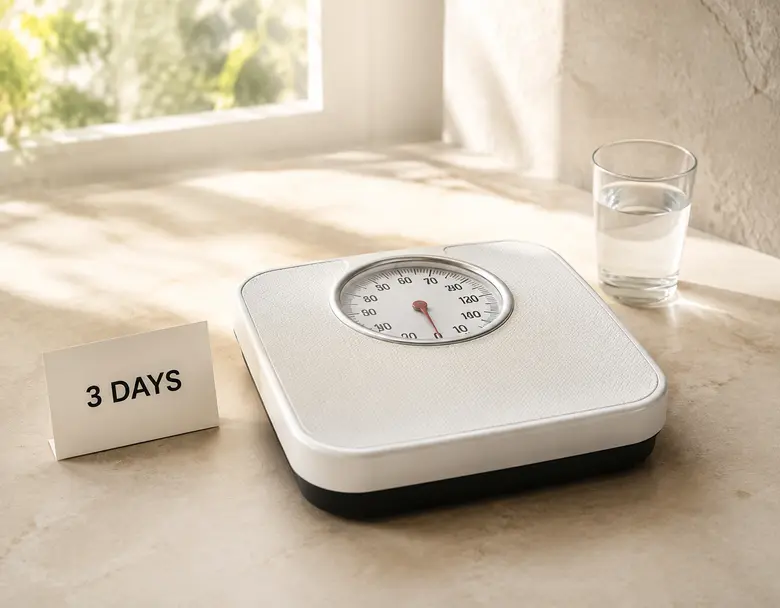
A 3-day fast can make the scale drop quickly, but that number is not the same as fat loss. Some of the change can come from less food in your digestive tract, fluid shifts, sodium changes, and glycogen-related water loss. Because 72-hour fasting is an extended fast and may be dangerous for some people, it should not be used as a quick weight-loss tutorial.[1]
Key takeaways
- The scale may move during a 3-day fast, but the result is not a clean measure of body fat.
- Regain after refeeding is common because food volume, fluids, sodium, and glycogen return.
- A 3-day fast is not a beginner weight-loss plan.
- Stop early if symptoms become severe, unusual, or unsafe.
- Gradual, steady weight loss is usually a better long-term expectation than chasing a large 3-day drop.[2]
Table of Contents
Why the scale can drop during a 3-day fast
When you stop eating for several days, the scale may fall for several reasons:
- There is less food moving through your digestive tract.
- Carbohydrate stores and the water stored with them may decrease.
- Sodium intake may change.
- Fluid intake, sweating, caffeine, and activity can shift water balance.
- Actual body fat may decrease if the fast creates an energy deficit.
Only the last item is fat loss. That is why a dramatic short-term drop can be misleading. It can look motivating on day three and partially reverse after normal meals return.
For a broader expectation-setting article, see weight loss from intermittent fasting.
So how much weight can you lose?
There is no responsible single number. A larger person may see a bigger scale change than a smaller person. Someone who ate more carbohydrate or sodium before the fast may see more water-weight movement. Someone who becomes dehydrated may see a drop that is not healthy progress.
Public health guidance frames sustainable weight loss much more slowly. CDC notes that people who lose weight gradually and steadily, about 1 to 2 pounds per week, are more likely to keep it off than people who lose weight quicker.[2] That does not mean the scale cannot change more over three fasting days; it means a fast scale drop should not be treated as the success metric.
A 3-day fast is not a quick weight-loss plan
Johns Hopkins Medicine cautions that longer fasting periods such as 24, 36, 48, and 72 hours are not necessarily better and may be dangerous.[1] Cleveland Clinic also warns that fasting too much or too long can contribute to dehydration, disrupted sleep, and mental stress.[3]
That matters because a 3-day fast can turn into a cycle:
- Restrict hard for a fast result.
- Feel depleted, anxious, or preoccupied with food.
- Refeed too aggressively.
- Regain water and food weight.
- Repeat the fast to get the scale back down.
That loop is not a stable weight-management strategy. If your goal is sustainable fat loss, intermittent fasting for weight loss is a safer direction than escalating fast length.
When should you avoid or stop a 3-day fast?
Do not do a 3-day fast if you are pregnant, breastfeeding, underweight, recovering from illness or surgery, have diabetes, kidney disease, an eating disorder or eating-disorder risk, or take medications that require food or timing guidance unless your clinician has specifically cleared it.[3]
Stop early and seek help if you have confusion, fainting, lack of urination, rapid heartbeat, rapid breathing, severe weakness, chest discomfort, repeated vomiting, or symptoms that feel unsafe. MedlinePlus lists confusion, fainting, lack of urination, rapid heartbeat, and rapid breathing as signs that need medical help right away in dehydration contexts.[4]
If the fast mostly creates dizziness, obsession, fear of eating, or a need to "earn" food, the issue is not willpower. The plan is wrong for you.
How to break a 3-day fast
Do not end a 3-day fast with a very large meal, alcohol-heavy meal, or an all-sugar meal. Cleveland Clinic recommends easing out of a fast and replenishing calories gradually.[3]
Start smaller, then reassess. Good first-meal options include:
- Soup with vegetables, beans, tofu, chicken, or rice
- Greek yogurt with fruit
- Eggs with toast and vegetables
- Oatmeal with nuts or yogurt
- Rice or potatoes with fish, tofu, or lean meat
If your stomach feels sensitive, wait before eating more. For detailed refeeding ideas, use breaking a fast gently.
What to do instead if your goal is fat loss
A less extreme plan is usually more useful:
- Choose a fasting window you can repeat without rebound eating.
- Eat enough protein and fiber during the eating window.
- Keep activity realistic.
- Protect sleep.
- Watch weekly trends, not a single post-fast weigh-in.
- Adjust if hunger, fatigue, or overeating increase.
GoFasting can help you log fasting windows, weight, water intake, steps, and calorie intake so you can review patterns over time, but it cannot tell you whether an extended fast is medically appropriate.
FAQ
Will I regain weight after a 3-day fast?
Some regain is normal after refeeding because food volume, fluids, sodium, and glycogen-related water return. That does not mean you failed.
Is a 3-day water fast safe?
It is not safe for everyone. A 3-day water fast is an extended fast and should be treated cautiously, especially if medical conditions, medications, pregnancy, breastfeeding, underweight status, kidney disease, diabetes, or eating-disorder risk are involved.[1][3]
How much fat can you lose if you stop eating for 3 days?
No article can give a precise fat-loss number for an individual. The scale change during a 3-day fast mixes fat, fluid, digestive contents, and glycogen-related water.
Should I do a 3-day fast before an event?
No. Using an extended fast for a quick appearance change raises the risk of dehydration, rebound eating, poor sleep, and feeling unwell during the event.
Bottom line
A 3-day fast may lower the scale, but it is a poor way to measure real fat loss and a risky way to chase fast results. If weight loss is your goal, build a repeatable routine instead of making the next fast longer.
Medical disclaimer
This article is for general education only and is not medical advice. Do not start a 3-day fast without medical guidance if you have a medical condition, take medication, are pregnant or breastfeeding, are underweight, have diabetes or kidney disease, are recovering from illness or surgery, or have a history or risk of disordered eating.
References
- Johns Hopkins Medicine. "Intermittent Fasting: What Is It, And How Does It Work?" Updated April 7, 2026 https://www.hopkinsmedicine.org/health/expert-qa/intermittent-fasting-what-is-it-and-how-does-it-work
- CDC. "Steps for Losing Weight." January 17, 2025 https://www.cdc.gov/healthy-weight-growth/losing-weight/index.html
- Cleveland Clinic. "6 Tips for Fasting Safely." March 5, 2024 https://health.clevelandclinic.org/tips-for-fasting-the-healthy-way
- MedlinePlus. "Dehydration." https://medlineplus.gov/dehydration.html