



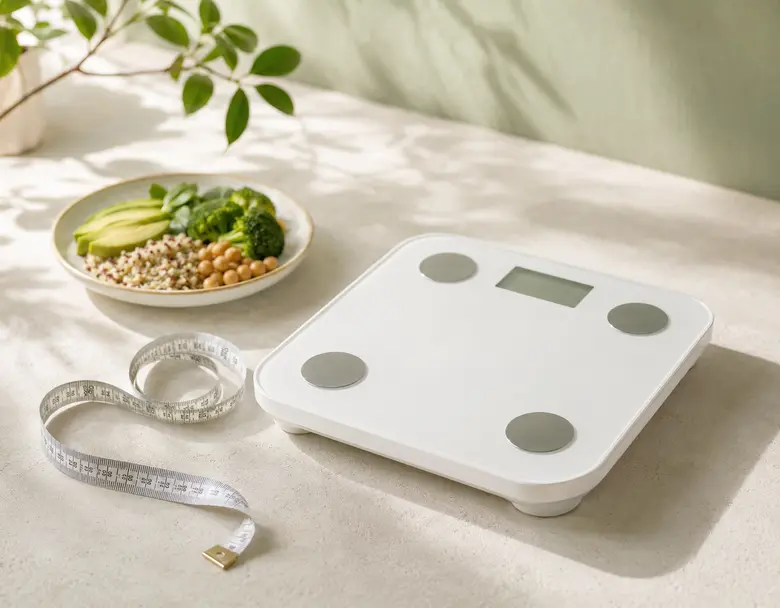
There is no guaranteed amount of weight you will lose with intermittent fasting. A realistic expectation is gradual progress shaped by your starting point, food intake, activity, sleep, stress, medications, health conditions, and how consistently you can follow the routine. Early scale changes may include water and digestive changes rather than body-fat loss.[1][2]
Key takeaways
- Fasting does not produce a fixed number of pounds or kilograms for everyone.
- A 5%–10% starting-weight goal over six months is a commonly used initial benchmark in structured weight-loss programs, not a promise for an individual.[2]
- Rapid early loss can reflect water, carbohydrate stores, food volume, and digestion.
- If progress stalls, review meals, drinks, snacks, activity, sleep, and weekends before fasting longer.
- Diabetes, pregnancy, breastfeeding, medication use, underweight, and eating-disorder history require professional guidance.[3]
Table of Contents
What is a realistic amount to lose?
Weight-loss response varies too much for an honest article to promise “X pounds in Y days.” Public-health guidance commonly describes gradual loss of about 1–2 pounds per week as more sustainable than faster loss, but this is a general reference, not a target that everyone should force.[1]
NIDDK describes an initial goal of 5%–10% of starting weight within six months for some people in structured programs. For example, at 200 pounds, that range would be 10–20 pounds over six months. Your appropriate goal may be different depending on health, age, medications, nutrition, and clinical advice.[2]
What can the scale show over time?
| Time frame | What may happen | How to interpret it |
|---|---|---|
| First week | Weight may drop, rise, or stay flat | Do not treat a few days as body-fat evidence |
| Weeks 2–4 | Meal timing and hunger patterns become clearer | Check whether the routine is repeatable |
| Months 1–3 | Weekly trends become more useful | Review meals, drinks, movement, and sleep |
| Up to 6 months | A modest trend may become meaningful | Reassess goals and health context |
Early scale movement deserves extra caution. Changes in carbohydrate intake, sodium, hydration, bowel contents, and meal volume can move body weight before a stable body-fat trend is visible. Conversely, a flat scale for a short period does not prove that no useful behavior has changed. Compare similar weigh-ins and look at a multi-week pattern.
Why do results vary?
Intermittent fasting may help by reducing eating opportunities, but it does not override total intake. Larger meals, grazing, sweetened drinks, alcohol, low activity, poor sleep, stress, medications, medical conditions, and different starting weights can all change the result.[1][2]
Research suggests intermittent fasting can produce weight loss in some adults, but studies vary in design and duration, and results are not consistently better than conventional calorie restriction.[4][5]
What should you do if you are not losing weight?
Before making the fast longer, review one to two weeks of normal behavior:
- portions and the size of the first meal;
- snacks across the eating window;
- sweetened coffee, juice, smoothies, and alcohol;
- protein and fiber in meals;
- steps, exercise, sleep, and stress;
- weekend intake and schedule consistency.
If the window feels harsh, shorten it. If you overeat when the window opens, improve meal structure. For a practical plan, see How to Use Intermittent Fasting for Weight Loss. For longer-term results and checkpoints, see Intermittent Fasting Results: 2 Weeks, 1 Month, 2 Months.
When should weight loss not be the main goal?
Do not pursue a faster number if fasting causes fainting, severe dizziness, persistent weakness, worsening headaches, sleep disruption, binge-restrict cycles, or anxiety around food. Get individualized advice if you have diabetes, take medication, are pregnant or breastfeeding, are underweight, are recovering from illness or surgery, or have another medical condition.[3]
FAQ
How much weight can you lose with intermittent fasting?
There is no universal amount. A gradual trend is more realistic than a guaranteed weekly number, and the result depends on the full eating and activity pattern.
Can you lose 10 pounds in two weeks with intermittent fasting?
That is not a safe or realistic promise. A large early scale change may include water and digestive contents, and trying to force rapid loss can increase risk. Use a longer trend and individualized guidance instead.[1][2]
How much weight can you lose in a month?
It varies. Use monthly data to review the direction and sustainability of the trend rather than comparing yourself with testimonials or a fixed online target.
Does 14:10, 16:8, or 18:6 determine how much weight you lose?
No schedule guarantees a specific amount. A longer window may reduce eating opportunities for some people, but portions, drinks, activity, sleep, health, and consistency still determine the overall pattern. Choose the least restrictive schedule that you can follow safely.[1][2]
Does intermittent fasting work if you do not count calories?
It can help some people reduce intake without detailed counting, but total energy intake still influences weight. Short-term tracking can reveal whether meals and drinks are offsetting the fasting structure.
Bottom line
Intermittent fasting has no guaranteed weight-loss amount. Set a gradual, individualized goal, judge trends over weeks and months, and improve the complete routine before making the fasting window more restrictive.
Medical disclaimer
This article is general educational information, not medical advice. Consult a qualified health professional before starting or changing fasting if you have diabetes, take medication, are pregnant or breastfeeding, are underweight, have an eating-disorder history, or feel unwell.
References
- CDC. Steps for Losing Weight https://www.cdc.gov/healthy-weight-growth/losing-weight/index.html
- NIDDK. Choosing a Safe & Successful Weight-loss Program https://www.niddk.nih.gov/health-information/weight-management/choosing-a-safe-successful-weight-loss-program
- Johns Hopkins Medicine. Intermittent Fasting: What Is It, And How Does It Work? https://www.hopkinsmedicine.org/health/expert-qa/intermittent-fasting-what-is-it-and-how-does-it-work
- Welton S et al. Intermittent fasting and weight loss: Systematic review https://pubmed.ncbi.nlm.nih.gov/32060194/
- Cochrane. Intermittent fasting, traditional dietary advice or no treatment: which works better to help adults living with overweight or obesity lose weight? https://www.cochrane.org/evidence/CD015610_intermittent-fasting-traditional-dietary-advice-or-no-treatment-which-works-better-help-adults