



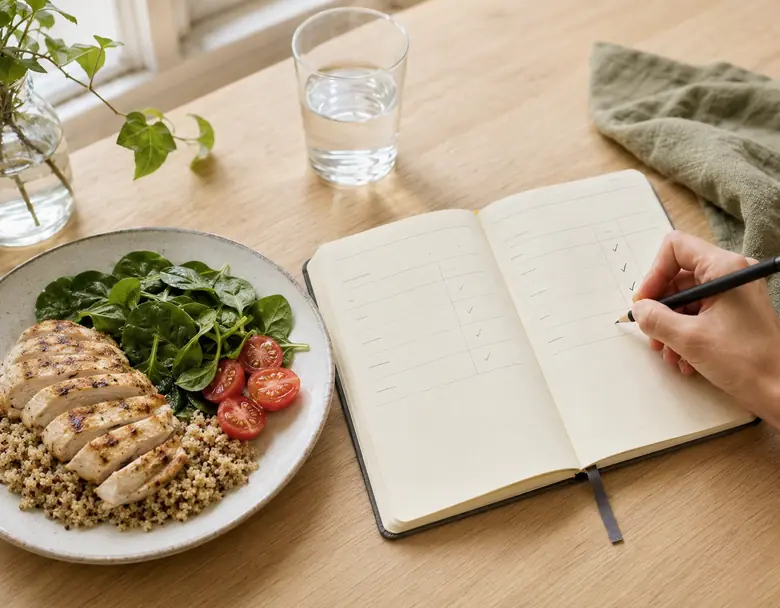
An intermittent fasting food tracker can help you see what happens inside your eating window. Fasting sets the timing, but meal quality, portions, drinks, snacks, and consistency still shape the routine. The goal of food logging is clarity, not perfection.[1][2]
Key takeaways
- Food logging can help you notice patterns in meals, snacks, drinks, and portions.
- Calorie tracking can be useful for some people, but it is not required for everyone.
- A fasting window does not guarantee a calorie deficit or balanced nutrition.[3]
- If tracking increases food anxiety, guilt, or binge-restrict cycles, stop tracking and seek support if needed.[4]
Table of Contents
What a food tracker adds to intermittent fasting
A fasting timer can show when you eat. A food tracker helps show what you eat and drink during the eating window. That difference matters because large meals, sugary drinks, grazing, low-protein meals, or low-fiber choices can all affect fullness and weight-management goals.
Monitoring eating, drinking, habits, and weight can be part of a behavior-change program, but it should not become a source of shame.[2]
What to log during your eating window
| What to log | Why it helps | Keep it simple |
|---|---|---|
| Meals | Shows whether you are eating enough real food. | Note the main foods, not every tiny detail. |
| Snacks | Reveals grazing patterns. | Look for timing and triggers. |
| Drinks | Sweet drinks and alcohol can be easy to miss. | Check calories and added sugars on labels.[5] |
| Protein foods | Helps you build more satisfying meals. | Include beans, poultry, fish, eggs, dairy, tofu, nuts, or other options that fit your diet.[6] |
| Fruits, vegetables, grains, and fiber | Supports meal quality and digestive regularity. | Add gradually if your intake is low.[7] |
| Calories, if useful | Can reveal portion patterns. | Use as information, not a score. |
How GoFasting can help with logging
GoFasting can help you log fasting windows, weight, steps, calorie intake, and water intake, then review patterns as you adjust your routine. That can make your fasting experiment easier to understand: Did your eating window shrink but your snacks increase? Did your water intake drop? Did steps change during a plateau?
Keep personal observations such as hunger, mood, digestion, sleep, or cravings separate from app-tracked product data unless the app explicitly supports them.
A simple three-day food logging reset
Try logging three ordinary eating-window days:
- One weekday that feels typical.
- One busier day when meals are less planned.
- One weekend or social day.
Afterward, look for one small adjustment. Examples: add protein to the first meal, replace one sugary drink, add a vegetable, move a snack into a planned meal, or widen the eating window if you are overeating because it is too tight.
When food logging may not be the right tool
Food logging is not the right next step if it makes you feel obsessive, guilty, secretive, or out of control around food. If tracking feeds binge-restrict cycles or fixation on weight or food control, stop the tracking experiment and seek qualified support.[4]
People with medical conditions, diabetes, pregnancy, breastfeeding, eating-disorder history, or medication needs should get individualized guidance before using fasting or calorie tracking for weight loss.
FAQ
Do I need to count calories while intermittent fasting?
No. Some people benefit from calorie awareness, but calorie counting is not required for everyone. You can also track meal patterns, drinks, protein, fiber, and consistency.
What is the difference between food logging and calorie tracking?
Food logging can be broad: meals, snacks, drinks, timing, and patterns. Calorie tracking focuses more specifically on energy intake.
Can food logging help with a fasting plateau?
It can help you spot changes in portions, drinks, snacks, and eating-window patterns. It does not diagnose the cause of a plateau, but it can make the next adjustment clearer.
Bottom line
A fasting food tracker is most useful when it helps you notice patterns and make one practical adjustment. Keep it simple, stay flexible, and do not let tracking become a source of pressure.
Medical disclaimer
This article is for general education only and is not medical advice. Ask a qualified health professional before changing your eating pattern if you have medical conditions, take medication, are pregnant or breastfeeding, are underweight, or have eating-disorder history.
References
- Johns Hopkins Medicine. Intermittent Fasting: What Is It, And How Does It Work? https://www.hopkinsmedicine.org/health/expert-qa/intermittent-fasting-what-is-it-and-how-does-it-work
- NIDDK. Choosing a Safe & Successful Weight-loss Program https://www.niddk.nih.gov/health-information/weight-management/choosing-a-safe-successful-weight-loss-program
- CDC. Physical Activity and Your Weight and Health https://www.cdc.gov/healthy-weight-growth/physical-activity/
- National Institute of Mental Health. Eating Disorders https://www.nimh.nih.gov/health/topics/eating-disorders
- FDA. How to Understand and Use the Nutrition Facts Label https://www.fda.gov/food/nutrition-facts-label/how-understand-and-use-nutrition-facts-label
- Harvard T.H. Chan School of Public Health. Protein https://nutritionsource.hsph.harvard.edu/what-should-you-eat/protein/
- NIDDK. Eating, Diet, & Nutrition for Constipation https://www.niddk.nih.gov/health-information/digestive-diseases/constipation/eating-diet-nutrition