



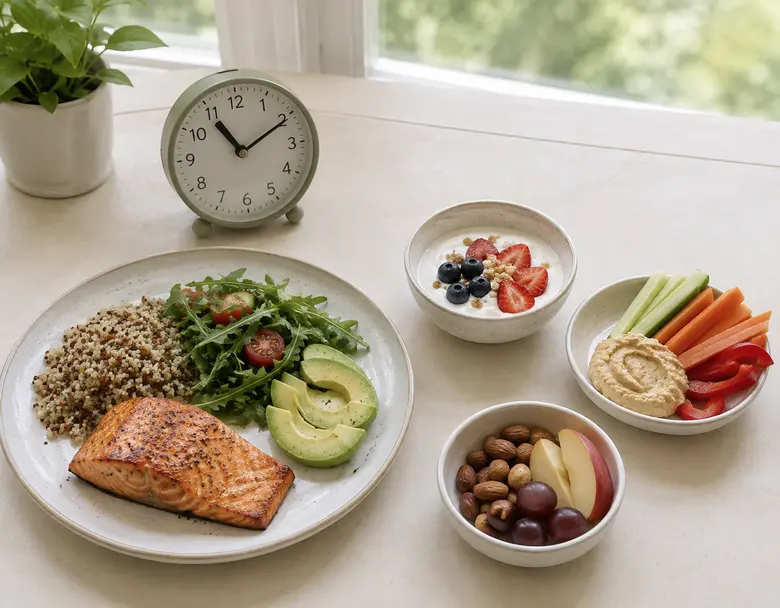
Intermittent fasting and small, frequent meals can both be used as eating structures for weight loss, but neither one automatically works better for everyone. The better choice is usually the one that helps you manage total intake, food quality, hunger, schedule friction, and consistency without making eating feel harder to sustain.
Key takeaways
- Intermittent fasting changes when you eat; small meals change how often you eat.
- Neither pattern guarantees weight loss if total calorie intake does not support the goal.
- Research does not clearly show intermittent fasting is superior to traditional dietary advice for weight loss in adults with overweight or obesity.[1]
- Small meals may feel easier for people who dislike long gaps without food, but frequent eating can also create more chances to snack.
- The most sustainable pattern is the one you can repeat while still eating enough nutrient-dense food and avoiding extreme restriction.
Table of Contents
- Key takeaways
- What Is Intermittent Fasting?
- What Does Eating Small, Frequent Meals Mean?
- Intermittent Fasting vs. Small Meals: Key Differences
- Which Pattern May Help with Appetite and Routine?
- What Matters More for Weight Change?
- Pros and Limitations of Each Approach
- How to Choose a Sustainable Eating Pattern
- FAQ
- Bottom line
- Medical disclaimer
- References
What Is Intermittent Fasting?
Intermittent fasting is an eating pattern that alternates between fasting periods and eating periods. Common versions include daily time-restricted eating, such as eating within an 8- to 10-hour window, or less frequent plans that limit food on certain days.[2]
For weight loss, intermittent fasting may help some people because it creates a clear boundary around eating time. Fewer eating opportunities can make it easier to skip late-night snacking, reduce grazing, or stop turning every long workday into an all-day eating window.
That structure is useful only if the eating window still supports the goal. A fasting window does not cancel out large portions, frequent high-calorie snacks, sugary drinks, or a pattern that leaves you so hungry that you overeat later. For a deeper look at the mechanism, see how intermittent fasting works for weight loss.
What Does Eating Small, Frequent Meals Mean?
Eating small, frequent meals usually means spreading food across the day in smaller eating occasions, such as three modest meals plus one or two snacks. The goal is often to avoid getting overly hungry, keep meals manageable, and make food feel less concentrated into one or two large sittings.
This approach can work well for some people because it reduces long empty stretches. It may also fit better when social meals, work breaks, training, or family schedules make a narrow eating window feel stressful.
Small meals are not automatically lower in calories, though. A "small meal" can still become extra intake if portions, drinks, snacks, and bites are not adding up in a way that supports the goal. The number of meals matters less than the total pattern.
Intermittent Fasting vs. Small Meals: Key Differences
The real difference is not that one pattern is "disciplined" and the other is "easy." They solve different problems.
| Dimension | Intermittent fasting | Small meals |
|---|---|---|
| Main structure | Limits eating to certain times | Spreads eating across more occasions |
| How it may reduce intake | Fewer eating opportunities | Smaller portions at each sitting |
| Main challenge | Hunger during fasting, social timing, overeating later | More planning, more food decisions, snack creep |
| Best fit | People who like clear time boundaries | People who feel better with shorter gaps between food |
| Weight-loss limit | Does not work if the eating window overcompensates | Does not work if frequent meals increase total intake |
If your biggest issue is unplanned evening eating, intermittent fasting may give you a useful boundary. If your biggest issue is arriving at dinner overly hungry and eating past comfort, smaller meals may be easier to repeat.
Which Pattern May Help with Appetite and Routine?
Appetite is personal. Some people feel calmer with fewer decisions: they know when they eat, when they stop, and when the kitchen is closed. Others feel worse with long gaps and do better when food is spaced out.
Meal-frequency research does not support a simple rule that more meals automatically improve body weight or body composition. Reviews of randomized trials suggest the evidence around meal frequency and weight outcomes is mixed, with limited certainty and no strong reason to treat frequent meals as a guaranteed weight-loss advantage.[3][4]
That does not make small meals useless. It means the value is practical, not magical. Small meals may help if they prevent intense hunger, reduce impulsive choices, or make a healthy eating plan easier to follow. Intermittent fasting may help if it reduces grazing and makes the day feel simpler.
GoFasting can support this kind of experiment by helping you log fasting windows, weight, steps, calorie intake, and water intake, then review patterns as you adjust your routine. The app cannot decide which approach is medically right for you, but tracking can make your own pattern easier to see.
What Matters More for Weight Change?
For weight change, the eating pattern has to support a realistic overall plan. A weight-loss program should include a healthy eating pattern that fits lower calorie needs, practical behavior changes, and support for keeping weight off.[5] The CDC also emphasizes that healthy weight management involves eating patterns, physical activity, sleep, stress, and other personal factors, not only one diet rule.[6]
This is why intermittent fasting and small meals can both fail in opposite ways:
- Fasting can fail when the eating window becomes too large, too calorie-dense, or too restrictive to sustain.
- Small meals can fail when "small" meals become frequent snacks, sweet drinks, or portions that quietly exceed the target.
- Both can fail when the plan ignores sleep, stress, activity, medical context, or food quality.
If you are mainly deciding between timing and calorie tracking, intermittent fasting vs. calorie counting may be the better next comparison.
Pros and Limitations of Each Approach
Intermittent fasting may be useful when you prefer clear start-and-stop rules. It can reduce decision fatigue and make eating feel more organized. It may also fit people who naturally prefer a later first meal or fewer daily eating occasions.
Its limitation is that the fasting window can become too rigid. If fasting leads to headaches, dizziness, irritability, overeating, or a pattern that feels socially difficult, the structure may be working against you. Longer or stricter fasting is not automatically better, and some people should get medical guidance before trying fasting.[2]
Small meals may be useful when long gaps make you feel distracted, very hungry, or more likely to overeat later. They can also help people who prefer predictable food breaks and do not want their day organized around a narrow eating window.
Their limitation is the planning load. Eating more often means more chances to make food decisions. Without enough structure, small meals can become all-day grazing, especially when snacks are calorie-dense or drinks add unnoticed calories.
For a broader comparison of eating styles, intermittent fasting vs. other diets can help separate timing, food type, restriction level, and lifestyle fit.
How to Choose a Sustainable Eating Pattern
Start with your main friction point.
If you eat often because food is always available, intermittent fasting may give you a cleaner boundary. A gentle overnight schedule can be a better first test than jumping into a long fast.
If you overeat because you wait too long between meals, small meals may be more realistic. Try building planned meals and snacks around protein foods, fiber-rich plants, satisfying carbohydrates, and water or unsweetened drinks instead of relying on willpower at the end of the day.
If you are not sure, test one pattern at a time for two to four weeks. Keep the test simple:
- Did hunger become easier or harder to manage?
- Did total intake become easier or harder to keep reasonable?
- Did meals become more nutritious or more chaotic?
- Did your schedule feel calmer or more strained?
- Could you imagine repeating this pattern most weeks?
Food quality still matters with either approach. If you want help separating fasting timing from eating-window nutrition, read does it matter what you eat while intermittent fasting?.
FAQ
Is intermittent fasting better than small meals for weight loss?
Not necessarily. Current evidence does not clearly show intermittent fasting is superior to traditional dietary advice for weight loss in adults with overweight or obesity.[1] It may work better for you if it helps you reduce eating opportunities and stay consistent.
Do small, frequent meals speed up metabolism?
There is not strong evidence that simply eating more often creates a meaningful weight-loss advantage. Meal frequency may affect hunger for some people, but total intake and food choices still matter.[3][4]
Can I lose weight without intermittent fasting?
Yes. Fasting is not required for weight loss. A realistic lower-calorie eating pattern, physical activity when appropriate, sleep, stress management, and long-term habits all matter.[5][6]
Which approach is easier to keep long term?
The easier approach is the one that reduces your biggest source of friction. Choose intermittent fasting if time boundaries help you. Choose small meals if long gaps make eating harder to manage.
Bottom line
Intermittent fasting and small meals are both structures, not guarantees. Intermittent fasting may help if clear time boundaries reduce grazing. Small meals may help if shorter gaps make hunger and food choices easier. For weight loss, the best choice is the pattern that helps you maintain a realistic calorie pattern, eat nutrient-dense foods, and keep going without turning every day into a struggle.
Medical disclaimer
This article is for general education only and is not medical advice. If you have diabetes, a history of eating disorder, pregnancy, breastfeeding, a chronic condition, symptoms during fasting, or take medication that depends on food timing, talk with a qualified health care professional before changing your eating schedule.
References
- Cochrane. "Intermittent fasting for adults with overweight or obesity." 2026 https://www.cochrane.org/evidence/CD015610_intermittent-fasting-traditional-dietary-advice-or-no-treatment-which-works-better-help-adults
- Johns Hopkins Medicine. "Intermittent Fasting: What Is It, and How Does It Work?" https://www.hopkinsmedicine.org/health/expert-qa/intermittent-fasting-what-is-it-and-how-does-it-work
- Schoenfeld BJ, Aragon AA, Krieger JW. "Effects of meal frequency on weight loss and body composition: a meta-analysis." Nutrition Reviews. 2015 https://pubmed.ncbi.nlm.nih.gov/26024494/
- Schwingshackl L, Nitschke K, Zähringer J, et al. "Impact of Meal Frequency on Anthropometric Outcomes: A Systematic Review and Network Meta-Analysis of Randomized Controlled Trials." Advances in Nutrition. 2020 https://pmc.ncbi.nlm.nih.gov/articles/PMC7490164/
- National Institute of Diabetes and Digestive and Kidney Diseases. "Choosing a Safe & Successful Weight-loss Program." https://www.niddk.nih.gov/health-information/weight-management/choosing-a-safe-successful-weight-loss-program
- Centers for Disease Control and Prevention. "Steps for Losing Weight." 2025 https://www.cdc.gov/healthy-weight-growth/losing-weight/index.html