



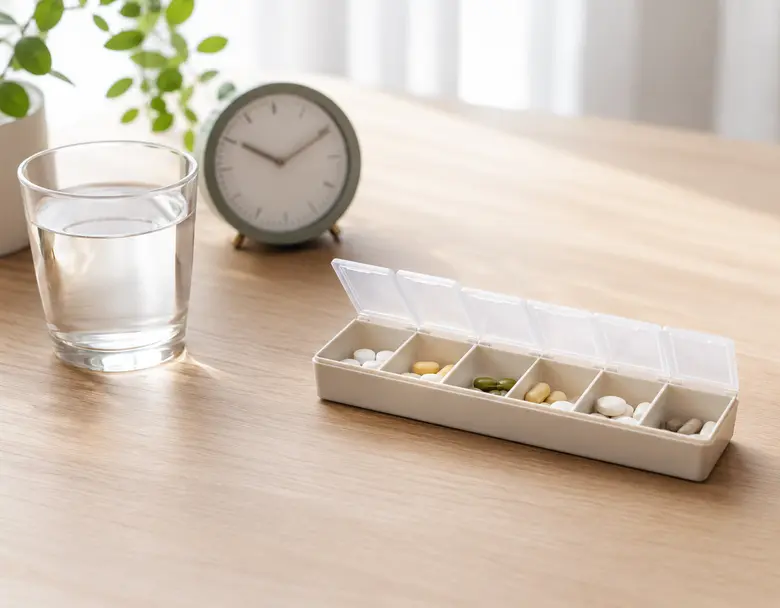
Often, you should continue taking medication as prescribed while intermittent fasting. The important question is not whether a pill technically breaks a fast; it is whether the medicine needs food or fluid, whether skipped meals change your blood-sugar risk, and whether fasting makes side effects harder to manage.[3] Do not stop, skip, delay, or change a dose to protect a fasting window. Ask the prescribing clinician or pharmacist how your medication fits with your eating schedule.
Key takeaways
- Medication safety comes before maintaining a fasting window.
- Some medicines need food to reduce stomach irritation or improve absorption.
- Insulin and some glucose-lowering medicines can make skipped meals dangerous because of hypoglycemia risk [1].
- Metformin and other medicines may have specific meal instructions; follow the prescription label and personal clinical advice [2].
- A pharmacist can review prescriptions, over-the-counter medicines, and supplements together.
- Do not use an app or a general fasting article to decide medication timing or dose changes.
Table of Contents
- Key takeaways
- Can you take medication while fasting?
- What to ask before starting or changing a fast
- Medicines and situations that need extra caution
- Diabetes medication and fasting
- Metformin, semaglutide, and other named medicines
- Supplements and fasting
- When to pause fasting and get help
- FAQ
- Bottom line
- Medical disclaimer
- References
Can you take medication while fasting?
Usually, you should keep taking medication exactly as prescribed rather than stopping it because you are fasting. Whether the dose can be taken during the fasting window depends on the specific medicine, your condition, the formulation, and the instructions on the label.
Fasting can affect medication in several ways:
- A medicine may need to be taken with food.
- Skipping meals may increase the risk of low blood sugar with some diabetes medicines.
- Reduced fluid intake may matter for some medicines or conditions.
- An empty stomach may make nausea, dizziness, or stomach irritation worse.
- Changing meal timing may conflict with a medicine that relies on a consistent schedule.
The safe answer cannot be determined from the medicine's name alone. A pharmacist or prescribing clinician can check the full list and help you choose an eating schedule that does not create avoidable risk.
What to ask before starting or changing a fast
Bring a current list of prescription medicines, over-the-counter products, vitamins, and supplements. Ask:
- Does any medicine need to be taken with food or a specific type of meal?
- Can any medicine make fasting, dehydration, or skipped meals less safe?
- Should any dose remain at its current time, even if it falls in the fasting window?
- If I have diabetes, do I need changes to glucose monitoring, food intake, or medication under supervision?
- What should I do if I develop nausea, dizziness, shaking, sweating, confusion, or unusual weakness?
- Is a shorter fasting period or a regular meal pattern safer for me?
If the answer is that medication and fasting do not fit comfortably, change the fasting plan rather than altering medication on your own.
Medicines and situations that need extra caution
| Situation | Why meal timing can matter | Safer next step |
|---|---|---|
| A label says “take with food” or “take after food” | Food may reduce irritation or be needed for absorption | Keep the label instructions and ask whether the dose should fall inside your eating window |
| Insulin or a sulfonylurea | Skipping or delaying meals can contribute to hypoglycemia | Create a clinician-guided plan for food, monitoring, and medication before fasting [1] |
| Metformin | It is commonly taken with meals to reduce stomach-related side effects, but instructions vary by formulation and person [2] | Ask your clinician or pharmacist before changing meal timing |
| Blood-pressure medicine or a diuretic | Dizziness, fluid balance, and blood pressure may become harder to interpret | Ask about hydration, monitoring, and symptoms that require help |
| Several prescriptions or supplements | Timing and interactions may be difficult to assess separately | Ask a pharmacist to review the complete list |
| A medicine with no food requirement | The dose may be flexible, but your condition still matters | Confirm the timing rather than assuming it is safe |
This table is a conversation starter, not a dosing guide. Even medicines in the same class can have different instructions.
Common mistakes to avoid
- skipping a prescribed dose because it falls inside the fasting window;
- moving a dose, splitting a tablet, or changing the dose without checking the label and prescriber;
- treating “calorie-free” as proof that a medicine is safe on an empty stomach;
- changing fasting, exercise, caffeine, and medication timing all at once;
- assuming an over-the-counter product or supplement has no interaction or food requirement.
If the medication schedule and fasting window conflict, the eating pattern should be changed. The goal is to fit fasting around safe treatment, not to force treatment around a timer.
Diabetes medication and fasting
Diabetes makes fasting a higher-stakes decision because meal timing, carbohydrate intake, physical activity, and medication can all affect blood glucose. People using insulin or medicines that stimulate insulin release may be at risk of hypoglycemia when meals are skipped or delayed [1].
Do not start intermittent fasting by simply removing breakfast, reducing a dose, or waiting longer to eat. A diabetes care team may need to review the fasting schedule, medication, glucose monitoring, activity, and what to do if your blood glucose falls. NIDDK advises people at risk of hypoglycemia to work with their health care team on prevention and treatment [1].
Symptoms such as shakiness, sweating, headache, confusion, or fainting should not be dismissed as ordinary fasting hunger. If you have diabetes and suspect low blood glucose, follow the treatment plan supplied by your diabetes team and seek urgent help for severe symptoms.
Metformin, semaglutide, and other named medicines
People often search for a simple yes-or-no answer about metformin or semaglutide. A safe article should not provide a universal schedule.
Metformin is commonly taken with meals to reduce gastrointestinal side effects, but the correct timing depends on the formulation and prescription instructions [2]. Do not move it into a fasting window just to keep a fast “clean.”
Semaglutide can affect appetite and digestion.[4] If it is combined with insulin or another medicine that can lower blood glucose, the prescribing information and clinical plan matter. A fasting window that further reduces food intake may make nausea, vomiting, dehydration, or inadequate nutrition harder to manage.
For either medicine, ask your prescriber or pharmacist:
- whether fasting is appropriate with your diagnosis and full medication list;
- whether the medicine must be taken with food;
- how to respond to low appetite, nausea, vomiting, or dizziness;
- whether glucose or other monitoring should change;
- what symptoms require urgent care.
Supplements and fasting
Supplements are not automatically safe just because they are sold without a prescription. Fat-soluble vitamins and oil-based products are often better taken with a meal containing fat, while powders, gummies, shakes, and sweetened products may contain calories or ingredients that affect a clean fast.
Check the label for calories, carbohydrates, fat, caffeine, sodium, directions about taking with food, and warnings for your condition. Ask a pharmacist if the label is unclear. Do not use fasting rules to override a supplement instruction prescribed for a medical reason.
When to pause fasting and get help
Pause the fasting routine and contact a clinician if you repeatedly experience dizziness, nausea, weakness, unusual fatigue, worsening symptoms, or difficulty eating enough. Seek urgent medical help for fainting, confusion, chest pain, severe dehydration, repeated vomiting, severe weakness, or signs of severe hypoglycemia.
The fasting warning signs and when to stop guide covers general warning signs. Medication-related symptoms still need medical assessment because they may have causes unrelated to fasting.
FAQ
Should I skip medication to keep my fast clean?
No. Do not skip, delay, or change a prescription dose to protect a fasting window. Follow the prescription and ask a pharmacist or clinician how to coordinate it with meals.
Does taking a pill break a fast?
A plain pill with water usually does not add meaningful calories, but that is not the main safety question. What matters is whether the medicine needs food, affects blood glucose, requires adequate fluid, or causes side effects on an empty stomach.
Can I fast if I take diabetes medication?
Possibly, but not without individualized guidance. Insulin and some other diabetes medicines can increase hypoglycemia risk when meals are skipped, so your diabetes team should guide any change in meal timing, monitoring, or medication [1].
Can I take medicine that says “take with food” during a fast?
Do not take it on an empty stomach simply to preserve the fast. Ask your pharmacist or prescriber whether it should be taken with a meal, whether the meal timing can change, or whether fasting is appropriate.
Can I take metformin while intermittent fasting?
Many metformin instructions involve taking it with meals, but the correct timing depends on your prescription and formulation. Ask your clinician or pharmacist before changing meal timing or dose.
Can I fast while taking semaglutide?
Do not assume it is safe. Semaglutide can affect appetite and digestion, and the risk profile may change when it is combined with other glucose-lowering medicines. Get a clinician-guided plan.
Bottom line
Medication comes before fasting. Keep taking medicines as prescribed, check whether food or fluid is required, and get a pharmacist or clinician to review your plan before changing meal timing. If the schedule causes symptoms or makes adequate food and hydration difficult, the fasting routine should be adjusted.
Medical disclaimer
This article is for general education only and is not medical advice. Never start, stop, skip, delay, or change medication based on this article. Seek advice from a qualified healthcare professional who knows your condition and medication list.
References
- NIDDK. Low Blood Glucose (Hypoglycemia) https://www.niddk.nih.gov/health-information/diabetes/overview/preventing-problems/low-blood-glucose-hypoglycemia
- MedlinePlus. Metformin https://medlineplus.gov/druginfo/meds/a696005.html
- NHS Specialist Pharmacy Service. Checking if medicines can be given with food https://www.sps.nhs.uk/articles/checking-if-medicines-can-be-given-with-food/
- DailyMed. Ozempic (semaglutide) prescribing information https://dailymed.nlm.nih.gov/dailymed/drugInfo.cfm?setid=f9e4fdb5-fb14-41ee-8b52-0e9d85f0823d