



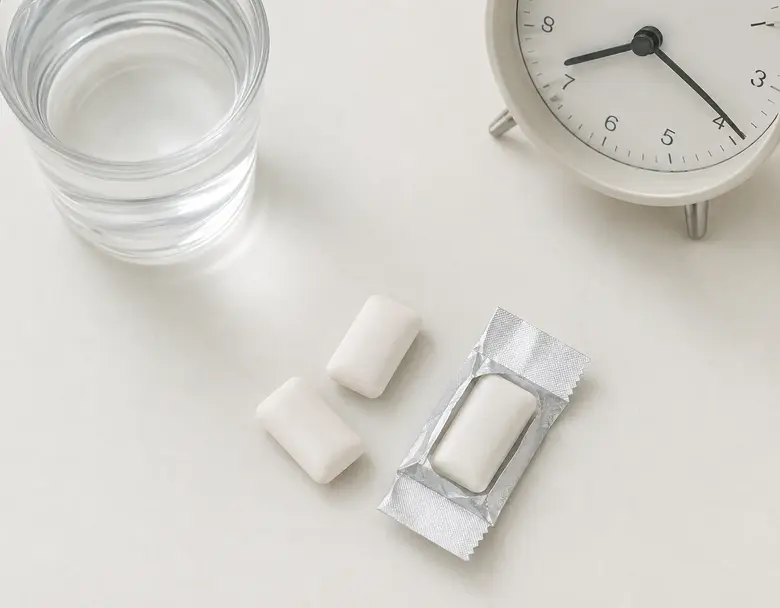
Regular gum with sugar belongs in the eating window. Sugar-free gum is a gray area: one piece may fit a flexible, practical intermittent fasting routine for some people, but it is not the cleanest choice for a strict fast. The label, your fasting goal, and whether gum increases cravings or digestive symptoms all matter.[1][2]
If you want the clearest fasting rule, skip gum and choose water, black coffee, or unsweetened tea if tolerated. If you are fasting for a medical procedure, laboratory test, surgery, religious observance, or clinician-directed plan, follow the specific instructions you were given rather than general intermittent fasting advice.
Key takeaways
- Sugar-containing gum should stay in the eating window.
- Sugar-free gum may fit some flexible routines, but it is not automatically calorie-free or appropriate for every fast.
- A clean or strict fast is simplest when you avoid gum and use plain fasting-window drinks.
- Check serving size, calories, carbohydrates, sugars, sugar alcohols, and sweeteners on the label.
- Gum may reduce the urge to snack for some people, but sweet taste or repeated chewing may increase hunger and cravings for others.
- Stop using gum during the fast if it causes bloating, gas, diarrhea, reflux, cravings, or repeated snacking.
Table of Contents
The simple answer
Whether gum breaks a fast depends on what you mean by “fast.”
| Fasting goal | Gum during the fasting window? | Practical rule |
|---|---|---|
| Strict clean or water-only fast | No | Use plain water unless your protocol says otherwise |
| Flexible intermittent fasting | Maybe | One low-calorie sugar-free piece may fit if it does not make the routine harder |
| Reducing late-night snacking | Maybe | Keep it only if it replaces snacking rather than triggering more eating |
| Medical test, procedure, or surgery | Follow instructions | Gum may be restricted even when it contains little or no sugar |
| Religious fast | Follow the rules of the observance | Do not substitute general diet advice |
The most consistent rule is: if gum contains sugar or meaningful calories, keep it in the eating window. If it is sugar-free, decide whether it supports your actual routine without claiming that it is identical to plain water.
Regular gum vs. sugar-free gum
Regular gum with sugar
Regular gum often contains sugar or other carbohydrates. Treat it as food and keep it in the eating window during a clean intermittent fast.
Sugar-free gum
Sugar-free gum may contain sweeteners such as xylitol, sorbitol, maltitol, aspartame, acesulfame potassium, or sucralose. Some products contain only a small number of calories, while others may list calories depending on the ingredients and serving size.[2][3]
That small amount may not change the overall results of a flexible routine for every person. However, “sugar-free” does not mean “nothing enters the digestive system,” and it does not make a product suitable for a strict water-only fast.
The practical question is not only whether one piece creates a measurable physiological response. It is also whether gum makes you think about sweet foods, chew several pieces, feel hungrier, or snack when the window opens. Those behavioral effects can matter more for consistency than trying to prove that gum is perfectly neutral.
What to check on the label
Do not rely only on “sugar-free,” “keto,” or “zero sugar.” Check the actual Nutrition Facts label and ingredient list for:
- serving size and number of pieces;
- calories per piece or serving;
- total carbohydrate and total sugars;
- sugar alcohols and other sweeteners;
- flavors or other ingredients that make cravings stronger;
- digestive warnings or your own tolerance.
If the gum contains sugar or meaningful calories, save it for the eating window. If it is very low calorie and sugar-free, it remains a personal choice for a flexible routine rather than a universal fasting rule.
Can sugar-free gum affect insulin or fat burning?
There is not one universal answer for every gum, person, or fasting goal. Sugar-free gum can contain different sweeteners and amounts of sugar alcohols, and people may respond differently. The available consumer guidance does not justify promising that sugar-free gum has no metabolic effect or that it improves fat loss.[1][2]
For everyday intermittent fasting, focus on the result that you can observe: does gum help you avoid an unplanned snack, or does it make the fasting window harder to repeat? If you need a strict calorie-free fast, the answer is simpler—skip gum.
When gum may help
Sugar-free gum may be useful when:
- you want fresher breath;
- you are replacing casual snacking with one planned piece;
- one piece does not make you hungrier or more focused on food;
- you are using it occasionally rather than chewing throughout the fasting window.
The American Dental Association notes that chewing sugarless gum after meals can increase saliva flow and support oral-health habits. That is an oral-health benefit, not evidence that gum improves fasting results.[4]
If your main need is a fasting-window drink or a broader list of low-calorie options, see what you can have during intermittent fasting.
When gum can make fasting harder
Keep gum in the eating window if:
- it increases hunger or sweet cravings;
- you chew piece after piece;
- it leads to snacking or overeating when the window opens;
- sugar alcohols cause bloating, gas, abdominal discomfort, or diarrhea;
- it causes reflux or nausea;
- you want the clearest clean-fast boundary.
If gum makes the fast feel more difficult, it is not helping the routine. Use plain water or another option that fits your fasting rules. The broader zero-calorie drinks and intermittent fasting guide can help you compare drink choices without turning gum into a default fasting tool.
What can you use instead of gum?
| Need | Simpler option |
|---|---|
| Dry mouth | Water |
| Morning flavor | Unsweetened tea |
| Caffeine | Plain black coffee if tolerated |
| Mouth freshness | Brush your teeth or use a routine approved by your dentist |
| Habit craving | A short walk, breathing exercise, or another non-food routine |
Water is the simplest fasting-window drink. Black coffee and unsweetened tea are also commonly used in everyday intermittent fasting, but they may not fit every medical or religious fasting protocol.[1]
A practical one-week test
If you are unsure whether gum helps, test the behavior rather than trying to make a universal physiological claim:
- Keep your fasting schedule and meals as similar as possible.
- Try one week without gum during the fasting window.
- If you choose to test it, use one sugar-free piece rather than continuous chewing during a comparable week.
- Record hunger, cravings, digestive comfort, snacking, sleep, and whether the fast was easy to repeat.
- Keep gum in the eating window if it does not improve consistency or causes symptoms.
This is a personal adherence experiment, not a medical test. Tracking can show how the routine feels, but it cannot determine whether fasting or gum is medically appropriate for you.
How to interpret the one-week test
Do not judge gum only by whether the scale changes. Compare whether it changes the number of unplanned snacks, the amount eaten when the window opens, digestive comfort, sleep, and how easy the schedule is to repeat. If the only benefit is a short distraction but it leads to continuous chewing or stronger cravings, it is not a useful fasting tool for that routine.
FAQ
Can you chew gum during intermittent fasting?
You can, but it is a gray area. For a clean or water-only fast, skip gum. For a flexible routine, one low-calorie sugar-free piece may fit if it does not increase cravings, digestive symptoms, or snacking.
Does sugar-free gum break intermittent fasting?
It depends on your fasting rule and the product label. Sugar-free gum may contain a small number of calories, sugar alcohols, sweeteners, or flavors. It does not fit the clearest strict fast, while some people may include it in a flexible routine.
Can I chew gum during a 16:8 fast?
The same rule applies during the 16-hour fasting window: regular gum with sugar belongs in the eating window. Sugar-free gum may fit a flexible routine for some people, but skip it if you want a strict clean fast or if it increases hunger.
Does gum with sugar break a fast?
Yes, for a clean intermittent fast. Sugar-containing gum provides carbohydrate and should stay in the eating window.
Is xylitol gum okay while intermittent fasting?
It may fit a flexible routine if the product is very low calorie and does not cause cravings or digestive discomfort. It is not a universal choice for a strict fast, and larger amounts of sugar alcohols can upset digestion for some people.
Can gum help with fasting hunger?
Sometimes. It may replace casual snacking for some people, while sweet taste or repeated chewing may make hunger and cravings stronger for others. Use your response as a practical signal.
What should I use instead of gum while fasting?
Plain water is the simplest option. Black coffee or unsweetened tea may also fit many everyday intermittent fasting routines if you tolerate them and your fasting rules allow them.
Bottom line
Regular gum with sugar belongs in the eating window. Sugar-free gum is a gray area that depends on the label, your fasting goal, and how it affects hunger, cravings, digestion, and consistency. If you want the clearest clean-fast rule, skip gum and choose plain water instead.
Medical disclaimer
This article is for general education only and is not medical advice. Follow your healthcare team’s instructions for medical tests, procedures, surgery, diabetes management, medications, pregnancy, breastfeeding, or other conditions. If fasting causes severe or persistent symptoms, stop and seek qualified medical guidance.
References
- Johns Hopkins Medicine. Intermittent Fasting: What Is It, And How Does It Work?
- U.S. Food & Drug Administration. Aspartame and Other Sweeteners in Food
- U.S. Food & Drug Administration. How to Understand and Use the Nutrition Facts Label
- American Dental Association. Chewing Gum