



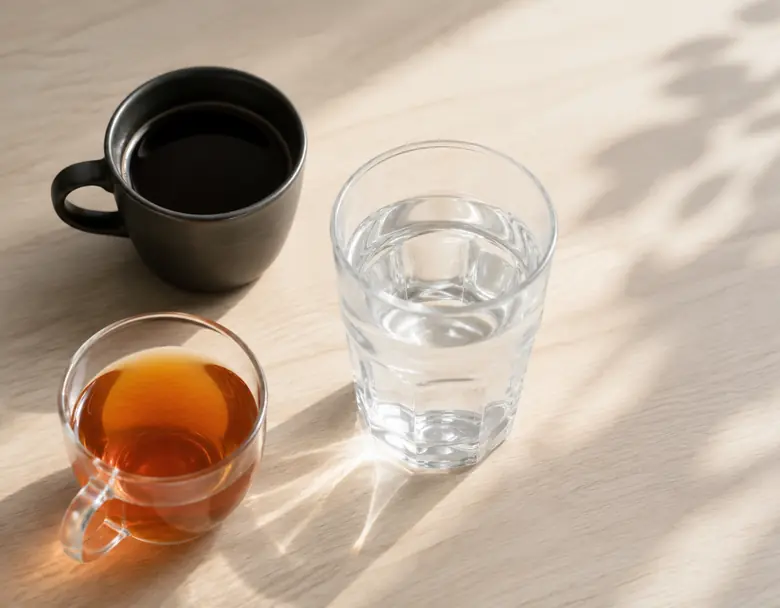
During a clean fasting window, the simplest choices are calorie-free drinks. Food, milk, cream, juice, alcohol, protein drinks, and other calorie-containing items belong in the eating window. The exact answer depends on your fasting goal, but the most reliable way to avoid confusion is to separate items that provide energy or nutrients from those that do not.[1]
Intermittent fasting is mainly about when you eat. It is not a license to ignore nutrition during the eating window, and it should not override medication instructions or medical advice.
Key takeaways
- Plain water is the simplest fasting-window choice. Detailed water and beverage questions are covered in the dedicated drink guide below.
- Black coffee and unsweetened tea can fit many everyday fasting routines if you tolerate caffeine, but their detailed rules belong on the beverage page.
- Food, milk, cream, sugar, juice, alcohol, protein shakes, and calorie-containing supplements should be placed in the eating window for a clean fast.
- Diet drinks, sweeteners, electrolytes, lemon water, gum, and supplements are gray areas; check ingredients and consider your goal and tolerance.
- A clean fast is a stricter calorie-free approach. A flexible fast may allow small extras, but it should be defined consistently.
- Diabetes, medication use, pregnancy, breastfeeding, kidney disease, and eating-disorder risk require medical guidance rather than a generic fasting rule.
Table of Contents
What can you have during the fasting window?
For a simple fasting-window rule, ask whether the item provides meaningful calories or nutrients. Plain water, black coffee, unsweetened tea, and other drinks with no meaningful calories may fit many clean-fast routines. Food and calorie-containing drinks do not.[2]
If your goal is the clearest fasting boundary, keep the list short. You do not need to find a special “fasting food” or supplement. For detailed guidance on water, coffee, tea, diet drinks, electrolytes, and lemon water, see what you can drink during intermittent fasting.
For the drink-specific questions, see what you can drink during intermittent fasting.
What belongs in the eating window?
For a clean fast, put anything with meaningful calories or nutrients into the eating window. This includes:
- meals and snacks;
- calorie-containing drinks, including milk, cream, juice, smoothies, soda, sweet tea, sports drinks, and energy drinks;
- alcohol;
- protein powder, collagen, amino-acid products, and protein shakes;
- candy, desserts, and packaged snacks.
These foods and drinks are not automatically unhealthy. They simply do not belong in a calorie-free fasting window. During the eating window, overall food quality, portion size, protein, fiber, and total energy still matter. Fasting does not cancel the basic principles of a balanced diet [3].
How to handle uncertain items
Some items do not fit a universal yes-or-no rule. Check the label for calories, sugar, protein, fat, and other nutrients, then compare the item with your fasting goal. Sweeteners and diet products also need an ingredient check rather than a universal assumption.[4] If you want the cleanest approach, place uncertain food, drink, and supplement products in the eating window.
Medication is different: follow the prescription and ask a pharmacist or clinician. Do not skip food or change dose timing to protect a fast. For detailed beverage questions, use the drink guide; for medication questions, see can you take medication while intermittent fasting.
Clean fasting versus flexible fasting
The phrase “fasting” can describe different practices. A clean fast usually means water and other genuinely calorie-free drinks only. A flexible approach may allow a small amount of milk, a diet drink, or another low-calorie item.
Neither label is useful if the rule changes every day. Choose the approach that fits your goal and is sustainable, then describe it accurately. If a small amount of milk makes the routine workable, that may be a practical choice for a flexible weight-management routine. It is not the same as a strict calorie-free fast.
Do not use the idea of a flexible fast to rationalize ignoring medication instructions, pushing through symptoms, or restricting food too aggressively.[5]
A goal-based way to decide gray-area items
| Your main goal | Clearest choice | How to handle gray-area items |
|---|---|---|
| Keep a strict calorie-free fast | Plain water and other clearly calorie-free drinks | Move milk, sweeteners, gum, supplements, lemon water, and electrolyte products to the eating window unless your protocol says otherwise |
| Reduce late-night grazing | A consistent eating cutoff and plain drinks | Keep an item only if it replaces snacking and does not lead to more eating later |
| Follow a medical, laboratory, or surgical fast | The instructions from your healthcare team | Do not apply general intermittent-fasting rules |
| Follow a religious fast | The rules of the observance | Do not substitute a weight-management definition |
This keeps “does it break a fast?” tied to the user’s actual objective. It also prevents a low-calorie product from being described as suitable for every type of fast.
What should you have when the eating window opens?
After a normal overnight or daily fast, you do not need a special detox drink or a reward meal. A balanced meal is usually a better starting point:
- protein such as eggs, fish, poultry, Greek yogurt, tofu, beans, or lentils;
- vegetables or fruit;
- a fiber-rich carbohydrate such as oats, potatoes, rice, quinoa, or whole-grain bread;
- healthy fats such as olive oil, avocado, nuts, or seeds;
- water or another suitable drink.
Eat at a comfortable pace and choose a portion that supports the rest of your day. If you have completed a prolonged fast, have a medical condition, or feel unwell, the question is not simply what you can have; ask a qualified professional whether fasting and refeeding are appropriate.
When fasting rules should not be self-guided
Talk with a qualified healthcare professional before starting or changing fasting if you:
- have diabetes or use insulin or glucose-lowering medication;
- take medicine that must be taken with food;
- have kidney, liver, heart, or gastrointestinal disease;
- are pregnant or breastfeeding;
- are under 18, underweight, or recovering from illness or surgery;
- have a current or past eating disorder;
- develop repeated dizziness, fainting, weakness, vomiting, or dehydration symptoms.
Fasting instructions for a medical test, procedure, or surgery may be stricter than everyday intermittent fasting. Follow the instructions from the relevant healthcare team.
FAQ
What can I have while intermittent fasting?
For a clean fasting window, choose plain water, unsweetened sparkling water, black coffee, or unsweetened tea. Meals, snacks, milk, juice, alcohol, protein drinks, and calorie-containing supplements belong in the eating window.
Can I have supplements while intermittent fasting?
It depends on the product. Protein, collagen, amino acids, gummies, oils, and other calorie-containing products should be placed in the eating window for a clean fast. Some supplements also need food or professional guidance.
What if I accidentally eat during a fast?
Do not turn one unplanned bite into an all-or-nothing decision. Record what happened if useful, resume a sensible routine, and avoid compensating with a longer or harsher fast. If accidental eating is linked to medication, low blood sugar, or distress around food, seek appropriate guidance.
Bottom line
For the clearest fasting window, have plain water, black coffee, or unsweetened tea. Put food, milk, cream, juice, alcohol, protein drinks, and calorie-containing add-ins in the eating window. Gray-area items should be judged by ingredients, fasting goal, tolerance, and medical context—not by a universal online rule.
Medical disclaimer
This article is for general education only and is not medical advice. Speak with a qualified healthcare professional before fasting if you have a medical condition, take medication, are pregnant or breastfeeding, are underweight, have eating-disorder risk, or feel unwell.
References
- Johns Hopkins Medicine. Intermittent Fasting: What Is It, And How Does It Work? https://www.hopkinsmedicine.org/health/expert-qa/intermittent-fasting-what-is-it-and-how-does-it-work
- CDC. About Water and Healthier Drinks https://www.cdc.gov/healthy-weight-growth/water-healthy-drinks/index.html
- Harvard T.H. Chan School of Public Health. Healthy Eating Plate https://nutritionsource.hsph.harvard.edu/healthy-eating-plate/
- U.S. Food & Drug Administration. Aspartame and Other Sweeteners in Food https://www.fda.gov/food/food-additives-petitions/aspartame-and-other-sweeteners-food
- Cleveland Clinic. 6 Tips for Fasting Safely https://health.clevelandclinic.org/tips-for-fasting-the-healthy-way