



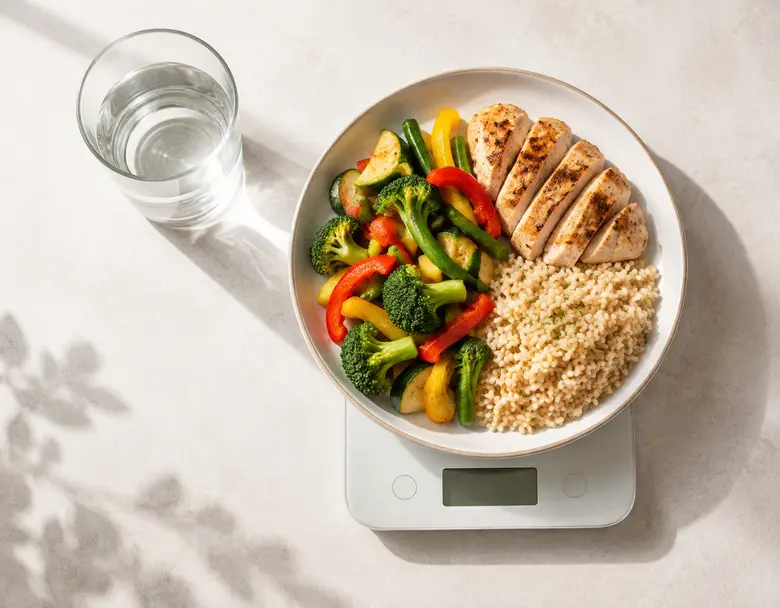
There is no single calorie target that works for everyone during intermittent fasting. Your needs depend on body size, age, sex, activity, health status, goals, and the fasting schedule you choose. A fasting window can organize when you eat, but it does not replace the need for enough nutritious food during the eating window.
Key takeaways
- Intermittent fasting does not create one universal calorie number.
- Calories during the eating window should match your goal, health context, and daily needs.
- Eating too little can backfire through fatigue, cravings, poor concentration, or overeating later.
- Eating too much during the window can work against weight goals.
- This topic is different from whether a small amount of calories breaks a fast.
Table of Contents
- Key takeaways
- Your calorie needs do not disappear during fasting
- Start with your goal, not the fasting clock
- During 16:8, should calories be lower?
- How to plan eating-window calories more realistically
- Do not confuse daily calories with calories that break a fast
- When tracking can help
- When calorie targets need professional guidance
- FAQ
- Bottom line
- Medical disclaimer
- References
Your calorie needs do not disappear during fasting
Intermittent fasting changes meal timing. It does not make your body stop needing energy, protein, fiber, fluids, vitamins, and minerals.
The CDC describes a healthy eating plan as one that emphasizes vegetables, fruits, whole grains, protein foods, dairy without added sugars, and healthy fats while staying within daily calorie needs [1]. That principle still applies during intermittent fasting.
If your eating window becomes too small to fit enough food, the schedule may be too strict. If your eating window turns into repeated oversized meals, the schedule may not support your goal either.
Start with your goal, not the fasting clock
The right calorie range depends on what you are trying to do.
If your goal is weight maintenance, your calories need to be close to what your body uses over time. If your goal is weight loss, a calorie deficit may be part of the plan, but it should still support enough nutrition and be realistic enough to maintain.
NIDDK notes that a weight-loss program should include a healthy, reduced-calorie eating and drinking plan, physical activity when appropriate, behavior change support, and a plan for keeping weight off [2]. That is bigger than simply skipping breakfast or compressing meals into fewer hours.
If you need the basics of creating a deficit, how to create a calorie deficit can help you think beyond the fasting window.
During 16:8, should calories be lower?
Not automatically. A 16:8 schedule gives you an 8-hour eating window, but it does not tell you how many calories to eat.
Some people naturally eat less because there are fewer eating opportunities. Others compensate with larger meals, extra snacks, sugary drinks, or calorie-dense foods. Harvard Health notes that the quantity and quality of food during the eating window still matter, and overcompensation can work against weight goals [3].
For 16:8, the more useful question is: can you fit balanced meals into the window without feeling deprived or overly full? If not, a wider window such as 14:10 may be easier to repeat.
For meal timing ideas rather than calorie targets, a 16:8 fasting meal plan may be a helpful companion.
How to plan eating-window calories more realistically
A practical calorie plan starts with your normal pattern. Instead of forcing a dramatic number, look at what usually happens during the eating window.
Ask:
- Are meals large enough to keep me steady?
- Am I getting protein at meals?
- Do I include fiber-rich foods such as vegetables, fruit, beans, or whole grains?
- Do drinks add more calories than I realize?
- Do I overeat after long fasts?
- Does the schedule leave me too tired to move normally?
The Harvard Healthy Eating Plate emphasizes vegetables and fruits, whole grains, healthy protein, healthy plant oils, and water, tea, or coffee with little or no sugar as a balanced meal-planning guide [4].
Do not confuse daily calories with calories that break a fast
This article is about how much to eat during your eating window. That is different from asking whether a small amount of calories interrupts a fasting window.
For example, deciding whether cream in coffee affects your fast is a fasting-window boundary question. Deciding how much to eat between noon and 8 p.m. is a daily intake question.
If your question is about fasting-window boundaries, how many calories break intermittent fasting is the more relevant page.
When tracking can help
You do not have to count calories forever. But short-term tracking can help if you are consistently undereating, overeating, or unsure why your routine feels hard.
GoFasting can help users log fasting windows, weight, steps, calorie intake, and water intake, then review patterns as they adjust their routine. Tracking should be used as feedback, not as a judgment of whether fasting is medically appropriate.
If you want a broader look at logging, food tracking during intermittent fasting explains what to log and why it can clarify patterns.
When calorie targets need professional guidance
Get individualized guidance if you have diabetes, take medication, are pregnant or breastfeeding, are underweight, have a history of eating disorders, are recovering from illness or surgery, or have a medical condition that affects nutrition.
A blog article can explain principles. It cannot safely calculate your personal intake needs.
FAQ
How many calories should I eat during 16:8 fasting?
There is no universal number. A 16:8 schedule changes your eating window, but your calorie needs still depend on your body, activity, health context, and goal.
Can I eat too little during intermittent fasting?
Yes. Eating too little can contribute to fatigue, cravings, poor concentration, overeating later, and difficulty maintaining the routine.
Can I eat anything during my eating window?
Technically the eating window is when food is allowed, but food quality still matters. Nutrient-dense meals are more useful than treating the window as permission to eat anything.
Bottom line
The number of calories you should eat during intermittent fasting depends on your personal needs, not the fasting schedule alone. Use the eating window to build steady, nutrient-dense meals, and adjust if the routine leads to overeating, undereating, or symptoms.
Medical disclaimer
This article is for general educational purposes only and is not medical advice. Talk with a qualified healthcare professional before changing calorie intake if you have a medical condition, take medication, are pregnant or breastfeeding, are underweight, have diabetes or blood sugar concerns, or have a history of eating disorders.
References
- CDC. "Tips for Healthy Eating for a Healthy Weight." https://www.cdc.gov/healthy-weight-growth/healthy-eating/index.html
- NIDDK. "Choosing a Safe & Successful Weight-loss Program." https://www.niddk.nih.gov/health-information/weight-management/choosing-a-safe-successful-weight-loss-program
- Harvard Health Publishing. "Should you try intermittent fasting for weight loss?" https://www.health.harvard.edu/blog/should-you-try-intermittent-fasting-for-weight-loss-202207282790
- Harvard T.H. Chan School of Public Health, The Nutrition Source. "Healthy Eating Plate." https://nutritionsource.hsph.harvard.edu/healthy-eating-plate/