



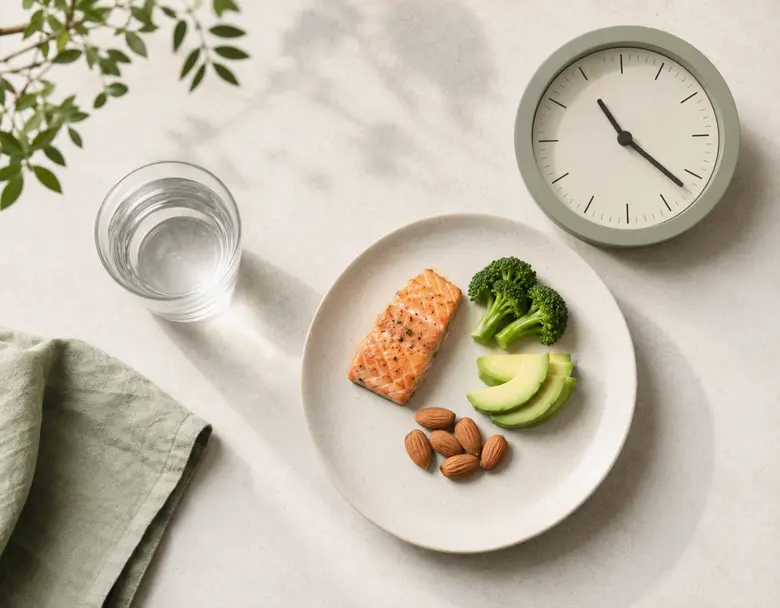
For a clean fast, any meaningful calories break the fasting window. There is no universal magic number of calories that keeps every fast “intact.” If a drink, food, supplement, creamer, collagen powder, or snack adds calories, treat it as an eating-window choice.[1][2]
For a more flexible fasting routine, a tiny amount of calories may not ruin consistency, but it does change the fast from strict to flexible. Be clear about your goal before deciding.
Key takeaways
- Clean fasting is simplest: water, black coffee, and unsweetened tea during the fasting window.[3]
- Calories measure how much energy a serving provides, and Nutrition Facts labels show calories by serving size.[1]
- Cream, milk, sugar, honey, juice, smoothies, protein shakes, collagen, MCT oil, and calorie-containing supplements belong in the eating window.
- “Zero-calorie” or “sugar-free” labels do not automatically answer every fasting question; check calories and ingredients.[4]
- Medication instructions matter more than fasting rules. Do not skip food required for a medicine just to preserve a fast.[5]
Table of Contents
Clean fasting vs flexible fasting
| Approach | Calorie boundary | Better fit |
|---|---|---|
| Clean fasting | No meaningful calories during the fast | Clear rules, simple drink choices |
| Flexible fasting | Small amounts may be tolerated by personal rules | Consistency-focused routines |
| Medical or medication-driven eating | Follow clinician or label instructions | Health needs come before fasting rules |
If you want the clearest answer, assume calories break the fasting window. If you choose flexibility, call it flexible rather than pretending it is the same as a clean fast.
Common calorie questions
| Item | Clean-fast answer | Why |
|---|---|---|
| Water | Does not break a clean fast | No calories |
| Black coffee | Usually fits | No milk, cream, or sugar |
| Unsweetened tea | Usually fits | No sweetener or calories |
| Coffee with cream | Breaks a clean fast | Adds calories and fat |
| Milk or plant milk | Breaks a clean fast | Adds calories, carbohydrate, protein, or fat |
| Collagen powder | Breaks a clean fast | Adds protein and calories |
| MCT oil | Breaks a clean fast | Adds fat and calories |
| Protein shake | Breaks a clean fast | Functions like food |
| Juice or smoothie | Breaks a clean fast | Adds calories and sugar |
| Gum or diet drink | Gray area | Check calories, sweeteners, and your goal |
For drink boundaries, read What other drinks can you drink?.
How to check labels for calories
Packaged drinks and supplements can be confusing. Check:
- Serving size
- Calories per serving
- Servings per container
- Added sugars
- Total carbohydrate, fat, and protein
- Ingredient list
Calories on the Nutrition Facts label refer to the listed serving size. If you consume more than one serving, you consume more calories and nutrients than the one-serving label shows.[1]
How many calories should I eat during intermittent fasting?
Your eating-window calories depend on your body, goals, activity, health conditions, medications, and overall eating pattern. Intermittent fasting does not create one calorie target for everyone.
If weight loss is a goal, a fasting window can be one structure for eating, but the full plan still needs an appropriate calorie pattern, healthy habits, and long-term follow-through.[6] If you have medical conditions or medications, calorie targets should be individualized with qualified guidance.
For food ideas, read What can I eat while intermittent fasting?.
Supplements, painkillers, and medications
Supplements and medications are not just fasting math.
- Gummies, powders, MCT oil, collagen, and protein supplements often add calories.
- Some supplements may upset your stomach when taken without food.
- Some medications need food or should not be stopped or delayed casually.[5]
- Painkillers should follow the label and clinician or pharmacist guidance.
If taking a medicine with food breaks your fasting window, protecting your health comes first.
FAQ
Will 5 or 10 calories break intermittent fasting?
For a clean fast, yes: meaningful calories break the fasting window. For a flexible routine, some people allow small amounts, but that is a personal rule, not a clean fast.
Does coffee creamer break a fast?
Yes for a clean fast. Creamer adds calories and often fat, sugar, or other ingredients, so it belongs in the eating window.
Does collagen break a fast?
Yes for a clean fast. Collagen adds protein and calories, so treat it as an eating-window supplement unless a clinician or dietitian gives different guidance.
Do zero-calorie sweeteners break a fast?
They may add few or no calories, but they still belong in a gray area rather than the cleanest default.[4] If sweet taste makes fasting harder, choose water, black coffee, or unsweetened tea.
How many calories should I eat during intermittent fasting?
There is no single number for everyone. Your calorie needs depend on your body, activity, health context, and goals. If weight loss or a medical condition is involved, individualized guidance is safer than using a generic target.
Bottom line
If you want a clean fast, keep the fasting window calorie-free: water, black coffee, and unsweetened tea. If a drink, supplement, or add-in has calories, put it in the eating window. Flexible fasting can still be useful, but it should be named honestly.
Medical disclaimer
This article is for general educational purposes only and is not medical advice. Follow medication labels and clinician or pharmacist guidance. Talk with a qualified health care professional before fasting if you have a medical condition, take medications, are pregnant or breastfeeding, are underweight, have a history of an eating disorder, or feel unwell while fasting.
References
- FDA. How to Understand and Use the Nutrition Facts Label https://www.fda.gov/food/nutrition-facts-label/how-understand-and-use-nutrition-facts-label
- Harvard T.H. Chan School of Public Health. Protein https://nutritionsource.hsph.harvard.edu/what-should-you-eat/protein/
- Johns Hopkins Medicine. Intermittent Fasting: What Is It, And How Does It Work? https://www.hopkinsmedicine.org/health/expert-qa/intermittent-fasting-what-is-it-and-how-does-it-work
- FDA. Aspartame and Other Sweeteners in Food https://www.fda.gov/food/food-additives-petitions/aspartame-and-other-sweeteners-food
- Cleveland Clinic. 6 Tips for Fasting Safely https://health.clevelandclinic.org/tips-for-fasting-the-healthy-way
- NIDDK. Choosing a Safe & Successful Weight-loss Program https://www.niddk.nih.gov/health-information/weight-management/choosing-a-safe-successful-weight-loss-program