



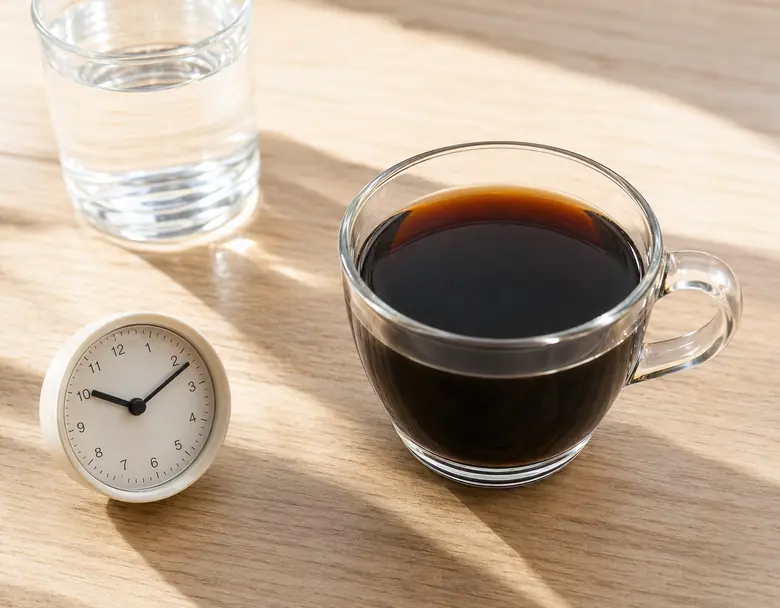
Yes. Plain black coffee can fit many intermittent fasting routines because it contains very little energy and no meaningful amount of carbohydrate, protein, or fat. Coffee with sugar, milk, cream, flavored syrups, collagen, protein powder, butter, or MCT oil is different: those additions provide calories or nutrients and are better kept in the eating window.[1][2]
The right answer also depends on the kind of fast. Black coffee may fit a practical time-restricted eating routine, but it does not fit a strict water-only fast or a medical fasting instruction. Caffeine tolerance, sleep, reflux, anxiety, medication, and pregnancy also matter.
Key takeaways
- Plain black coffee usually fits a practical intermittent fasting window.
- Coffee with sugar, milk, cream, syrups, collagen, protein powder, butter, or MCT oil belongs in the eating window for a clean fast.
- Zero-calorie sweeteners are a gray area: they may fit a flexible calorie-control routine, but they are not the cleanest default for everyone.
- Morning coffee is usually easier to reconcile with sleep than afternoon or evening coffee.
- Coffee can make a fasting window feel easier for some people, but it is not a guaranteed fat-loss or metabolic shortcut.
- If coffee causes jitters, palpitations, reflux, anxiety, poor sleep, dizziness, or unusual fatigue, reduce it or move it to the eating window.
Table of Contents
- Key takeaways
- Quick answer
- What coffee fits during intermittent fasting?
- Which coffee add-ins break a clean fast?
- What about zero-calorie sweeteners?
- Does coffee help with fasting or fat loss?
- When should you drink coffee while fasting?
- Coffee, fasting, and exercise
- Common coffee mistakes during fasting
- A simple seven-day coffee and fasting test
- When coffee may make fasting harder
- Who should be more cautious?
- FAQ
- Bottom line
- Medical disclaimer
- References
Quick answer
For most people following everyday intermittent fasting, one serving of plain black coffee can fit the fasting window. Brewed black coffee, espresso, Americano, and unsweetened cold brew are practical examples as long as they do not contain calorie-containing additions.[1][2]
Coffee becomes an eating-window drink when you add milk, cream, sugar, honey, syrup, protein powder, collagen, butter, MCT oil, or another meaningful source of calories. A “sugar-free,” “keto,” or “zero-sugar” label does not by itself answer the question; check the serving size, calories, fat, carbohydrate, protein, and added sugars on the label.[2]
If you are following a medical, laboratory, surgical, or religious fast, use the instructions for that fast. Do not replace them with general intermittent fasting advice.
What coffee fits during intermittent fasting?
| Coffee choice | Fit for a clean fasting window | Practical note |
|---|---|---|
| Plain brewed black coffee | Usually fits | No sugar, milk, cream, or oil |
| Plain espresso | Usually fits | Keep it unsweetened |
| Americano | Usually fits | Espresso and water only |
| Unsweetened cold brew | Usually fits | Check bottled versions for added sugar or milk |
| Coffee with a small amount of cinnamon | Usually flexible | Avoid sweetened spice blends |
| Coffee with milk or cream | Eating window | Adds calories and nutrients |
| Sweetened coffee or latte | Eating window | Adds sugar, milk, or both |
| Protein or collagen coffee | Eating window | Adds protein and calories |
| Bulletproof-style coffee | Eating window for a clean fast | Butter and MCT oil add fat and calories |
The practical rule is simple: if the drink is plain and close to calorie-free, it may fit an everyday fasting routine. If it contains meaningful calories or makes you treat the fasting window like a snack period, keep it in the eating window. For a broader comparison of fasting beverages, see what you can have during intermittent fasting and zero-calorie drinks and intermittent fasting.
Which coffee add-ins break a clean fast?
Milk, cream, and plant milk
Milk and cream provide calories and may provide protein, fat, carbohydrate, or lactose. Sweetened plant milks and flavored creamers can add even more sugar. They may still fit your overall eating plan, but they do not belong in a clean calorie-free fasting window.
Sugar, honey, maple syrup, and flavored syrups
Sugar-based additions add carbohydrate and calories. Honey and maple syrup are not exceptions simply because they are less processed or sound more natural. Flavored syrups and sweetened coffee drinks also reinforce a sweet taste that can make plain coffee or the next meal less satisfying for some people.
Collagen and protein powder
Collagen and protein powder provide protein and calories. They may be useful in an eating-window drink, but they should not be described as fasting-window coffee for a clean fast.
Butter, MCT oil, and bulletproof coffee
Butter and MCT oil add fat calories. Bulletproof-style coffee may fit a low-carbohydrate or ketogenic eating pattern, but it is not the same as plain black coffee and does not preserve a traditional calorie-free fast.
Alcohol-based or bottled coffee drinks
Alcohol, bottled coffee drinks, sweetened cold brews, and ready-to-drink lattes should be treated as eating-window items when they contain calories, sugar, milk, cream, or other macronutrients.
What about zero-calorie sweeteners?
Zero-calorie sweeteners are a gray area rather than a universal yes or no. Some provide few or no calories, but individual responses and practical effects can vary. If a sweetener increases cravings, makes you think about food more often, or leads to overeating when the window opens, it is not helping your routine.[5]
For the cleanest fasting rule, use plain coffee. For a flexible calorie-control routine, some people may choose a zero-calorie sweetener and monitor whether it supports or undermines consistency. Describe that as flexible fasting rather than treating it as identical to a strict fast.
Does coffee help with fasting or fat loss?
Coffee may make a fasting window feel easier for some people because caffeine can increase alertness and may temporarily reduce appetite. Caffeine can also increase fat oxidation during exercise, but that does not prove that coffee guarantees faster fat loss or makes up for an unsuitable eating pattern.[4]
The more useful question is whether coffee helps you follow a balanced, repeatable routine. If coffee only hides strong hunger, allows you to extend an uncomfortable fast, or leads to overeating later, it is working against the plan.
Intermittent fasting still depends on the overall eating pattern. During the eating window, include enough food, protein, fiber-rich plants, and fluids. Coffee should support the routine, not replace meals or become a way to ignore symptoms.
When should you drink coffee while fasting?
Morning coffee is often the simplest option because it can support alertness while leaving more time before sleep. Caffeine remains active for hours, and a controlled study found that 400 mg taken at bedtime or several hours beforehand disrupted sleep.[3]
There is no need to use the upper safety reference as a personal target. EFSA reports that single doses up to 200 mg and daily intakes up to 400 mg do not raise safety concerns for most healthy, non-pregnant adults, but tolerance varies by person.[2]
Move your last coffee earlier if you notice lighter sleep, trouble falling asleep, anxiety, palpitations, or stronger next-day hunger. Poor sleep can make a fasting schedule harder to repeat.
Coffee, fasting, and exercise
Coffee and fasted exercise can fit together for some people, but the combination is not automatically better. Caffeine may increase fat oxidation during exercise, while a longer fast or harder workout may also increase the chance of feeling weak, shaky, dizzy, or nauseated.[4]
If you already tolerate caffeine and fasting, one plain coffee before a moderate walk or workout may be a reasonable personal test. Start with a small amount rather than a performance-level dose. Do not use coffee to push through dizziness, chest pain, fainting, unusual fatigue, or other warning signs. For broader safety guidance, see fasting warning signs and when to stop.
Common coffee mistakes during fasting
The coffee itself is not always the reason a fasting routine feels difficult. Watch for these patterns:
- Turning black coffee into a meal. Butter, MCT oil, cream, protein powder, and collagen add calories and nutrients even when the drink is marketed as “fasting coffee.”
- Using caffeine to ignore symptoms. Coffee should not be used to push through dizziness, shaking, faintness, nausea, or unusual weakness.
- Adding coffee late in the day. A fasting window that looks successful on paper but repeatedly damages sleep may be a poor fit.
- Assuming “sugar-free” means neutral. Check the full label and notice whether sweet taste increases cravings or later overeating.
- Changing coffee and fasting at the same time. If you normally drink coffee with milk, test the coffee change separately from any change in fasting hours so you can identify what affects you.
These are troubleshooting points, not reasons to label a food or drink universally good or bad.
A simple seven-day coffee and fasting test
If you want to know whether coffee supports your routine, keep the test modest:
- Days 1–2: Record your usual coffee, add-ins, timing, hunger, sleep, and digestion without changing the fasting window.
- Days 3–4: If appropriate, test plain coffee earlier in the day and keep the rest of the routine similar.
- Days 5–7: Review whether coffee helped consistency or instead increased jitters, reflux, cravings, late-day alertness, or rebound eating.
Keep the version that supports a repeatable routine. If caffeine is the variable causing problems, decaf or an unsweetened non-caffeinated drink may be a better fasting-window choice.
When coffee may make fasting harder
Reduce coffee, change its timing, shorten the fast, or move coffee into the eating window if you notice:
- shakiness, anxiety, or a racing heartbeat;
- reflux, nausea, or stomach discomfort;
- headaches that persist or recur;
- poor sleep after afternoon or evening caffeine;
- using coffee to suppress strong hunger every day;
- rebound eating when the eating window opens;
- dizziness, weakness, or feeling unsafe while fasting.
If you need several cups of coffee to complete a fasting window, reassess the fasting window and the quality of your meals. A sustainable schedule should not depend on escalating caffeine.
Who should be more cautious?
Talk with a qualified healthcare professional before combining fasting and caffeine if you:
- are pregnant or breastfeeding;
- have anxiety, panic symptoms, insomnia, uncontrolled high blood pressure, reflux, or heart rhythm concerns;
- have diabetes or take medication affected by food, caffeine, hydration, or meal timing;
- have a current or past eating disorder or significant anxiety around food or body weight;
- are underweight, recovering from illness or surgery, or have another condition that changes your nutrition needs.
ACOG states that moderate caffeine intake of less than 200 mg per day is generally considered acceptable during pregnancy, but fasting during pregnancy should be discussed with a clinician.[6] Do not change prescription medication or use coffee to override medical fasting instructions.
FAQ
Can I drink coffee while intermittent fasting?
Yes. Plain black coffee can fit many everyday intermittent fasting routines. Keep milk, cream, sugar, syrups, protein, collagen, butter, and MCT oil in the eating window for a clean fast.
Does coffee break a 16:8 fast?
Plain black coffee usually fits a practical 16:8 fasting window. Coffee with calorie-containing additions should be treated as an eating-window drink.
Can I drink coffee with milk while fasting?
For a clean fast, save milk and cream for the eating window because they add calories and nutrients. A flexible calorie-control routine may use a different rule, but it should be described honestly as flexible rather than calorie-free fasting.
Does bulletproof coffee break a fast?
Yes, for a traditional clean fast. Butter and MCT oil add fat and calories. Bulletproof coffee may fit a ketogenic eating pattern, but it is not plain black coffee.
Can I drink decaf coffee while fasting?
Plain decaf coffee can fit many fasting routines because it contains minimal calories. It does not provide the same caffeine effect, but it may be useful if caffeine affects your sleep, anxiety, reflux, or heart rate.
Can zero-calorie sweetener go in fasting coffee?
It depends on your fasting goal and how the sweetener affects you. Plain coffee is the cleanest default. If a sweetener increases cravings or makes the routine harder to repeat, keep it out of the fasting window.
Can coffee help with fasting headaches?
Coffee may help if a headache is related to caffeine withdrawal, but headaches can also be related to hydration, sleep, meal timing, or another health issue. Persistent or severe headaches are a reason to stop and reassess rather than increase caffeine.
Bottom line
Plain black coffee can fit many intermittent fasting routines. Keep calorie-containing additions in the eating window, treat sweeteners as a personal gray area, drink caffeine early enough to protect sleep, and stop using coffee as a way to force an overly restrictive fast.
If you are new to fasting, a moderate schedule and balanced meals are more important than adding more coffee. GoFasting can help you record fasting windows, water, meals, steps, and weight trends so you can judge whether the routine is genuinely repeatable.
Medical disclaimer
This article is for general education only and is not medical advice. Speak with a qualified healthcare professional before changing fasting or caffeine habits if you are pregnant, breastfeeding, under 18, underweight, taking medication, managing a medical condition, or have a history of an eating disorder. Seek urgent medical help for severe symptoms such as fainting, chest pain, trouble breathing, seizures, or severe confusion.
References
- Johns Hopkins Medicine. Intermittent Fasting: What Is It, And How Does It Work?
- EFSA Panel on Dietetic Products, Nutrition and Allergies. Scientific Opinion on the safety of caffeine. EFSA Journal. 2015;13(5):4102.
- Drake C, Roehrs T, Shambroom J, Roth T. Caffeine effects on sleep taken 0, 3, or 6 hours before going to bed. Journal of Clinical Sleep Medicine. 2013;9(11):1195–1200.
- Collado-Mateo D, et al. Effect of acute caffeine intake on the fat oxidation rate during exercise: a systematic review and meta-analysis. Nutrients. 2020;12(12):3603.
- Pepino MY. Metabolic effects of non-nutritive sweeteners. Physiology & Behavior. 2015;152(Pt B):450–455.
- American College of Obstetricians and Gynecologists. Moderate caffeine consumption during pregnancy. Committee Opinion No. 462.