


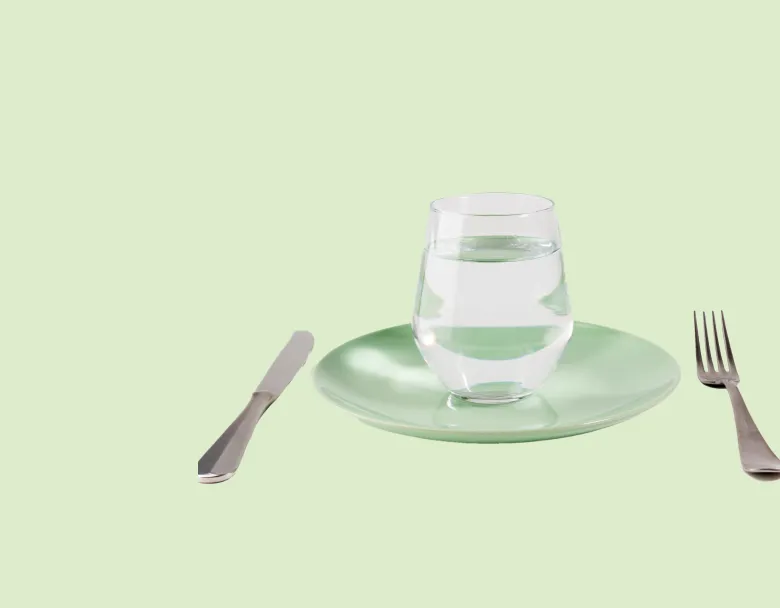
Water fasting means consuming only water and no food for a continuous period. It is different from everyday intermittent fasting, where food is still eaten within a set window. Because water fasting removes calories, protein, and food-based nutrients entirely, the longer it lasts, the more important the safety questions become. \[1\]\[2]
This is a general overview, not a water-fasting schedule, a medical clearance, or a protocol for returning to food. Medical, laboratory, surgical, and religious fasting follow their own rules and should not be replaced with general online advice.
Key takeaways
- Water fasting means water only; coffee, tea, gum, supplements, electrolyte products, and flavored drinks change the definition or require a separate question.
- It is different from time-restricted eating, because everyday intermittent fasting still includes daily nutrition.
- Fuel use changes after food stops, but this is normal adaptation—not proof of detoxification, disease treatment, fat-loss success, or another guaranteed benefit. \[1\]\[2]
- Longer fasts add risks involving fluid balance, blood pressure, medicines, electrolytes, and returning to food. \[2\]\[3]
- Pregnancy, breastfeeding, adolescence, low body weight, eating-disorder history, diabetes, relevant medicines, and chronic conditions are reasons not to self-direct water fasting. \[1\]\[2]
Table of Contents
- Key takeaways
- How water fasting differs from intermittent fasting
- What happens during a water fast
- Why longer water fasts add risk
- What a general overview cannot tell you
- Who should not self-direct water fasting
- When to stop and seek care
- Returning to food is part of the safety question
- FAQ
- Bottom line
- Medical disclaimer
- References
How water fasting differs from intermittent fasting
| Question | Everyday intermittent fasting | Water fasting |
|---|---|---|
| What is consumed? | Food is eaten in a planned window | Water only, no food |
| Does daily nutrition continue? | Yes | No, for the continuous fasting period |
| Main decision | Whether the eating window is workable | Whether going without food is medically appropriate and safe |
| What this page covers | Not a schedule guide | The definition, limits, risks, and when to seek care |
Some fasting methods allow reduced calories or other beverages, but those are modified approaches rather than a strict water-only fast. A water-only definition is deliberately simple; it should not be stretched to fit gum, supplements, electrolyte products, coffee, tea, or flavored drinks.
What happens during a water fast
After food stops, the body draws on available fuel stores and changes how it provides energy. In the earlier part of a fast, it uses glucose from recent food and stored carbohydrate. As fasting continues, it increasingly uses stored fuel and produces ketones. \[1\]\[2]
That shift is an explanation of how the body adapts to no food. It is not evidence that a water fast is necessary, safe for an individual, or more effective than a less restrictive eating pattern. Research on prolonged water fasting is limited, and many studies were conducted with medical supervision, so findings should not be converted into a home protocol. \[2\]\[3]
Hunger, headache, tiredness, dizziness, irritability, or difficulty concentrating can occur. They are not achievements to push through, and they do not prove that fasting is “working.”
Why longer water fasts add risk
Duration changes the question. A longer period without food can make fluid balance, blood pressure, nutrient intake, medication timing, and electrolyte balance harder to manage. People also differ in their starting health, usual diet, activity, medicines, and access to medical support.
Reports on water-only fasting safety come from structured programs with screening and supervision. That does not mean an unsupervised multi-day fast has the same safeguards. [3] For this reason, this page does not recommend a number of hours or days, and it does not compete with specific 36-, 48-, or 72-hour guidance.
If your actual question is about a single food or drink in an ordinary intermittent-fasting window, use what breaks an intermittent fast rather than applying water-fast rules to every fasting pattern.
What a general overview cannot tell you
A generic description cannot tell you whether a particular water fast is appropriate, how your blood pressure or blood sugar will respond, whether a medicine needs food, or whether a symptom is harmless. It also cannot turn supervision used in research into a home checklist.
Be cautious with online claims that a specific number of fasting hours guarantees a particular metabolic stage, autophagy result, detox effect, or amount of fat loss. People use the term “water fasting” for different goals, but a change in fuel use does not answer whether the fast is a good choice for a particular person. \[1\]\[2]
Water fasting should also not be used as compensation after overeating, alcohol use, or a missed health goal. Turning food into a reason for punishment can make the pattern more restrictive and obscure whether it is serving your health.
Who should not self-direct water fasting
Do not use a general web guide to decide on water fasting if any of the following applies:
- You are pregnant, breastfeeding, under 18, underweight, malnourished, or recovering from illness or surgery.
- You have a current or past eating disorder or restrictive-eating pattern.
- You manage diabetes, blood-sugar episodes, kidney, heart, liver, or another chronic condition.
- You take insulin, glucose-lowering medicine, medicine that must be taken with food, or other regular medicines whose timing may matter.
Do not stop, skip, delay, or adjust prescribed medicine to make a fast work. A clinician or pharmacist should advise on medicine instructions and whether fasting is appropriate at all. \[1\]\[2]
When to stop and seek care
Seek urgent medical help for fainting, chest pain, a racing or irregular heartbeat, confusion, severe weakness, repeated vomiting, severe or persistent abdominal pain, or signs of serious dehydration. [3]
Stop the fast and seek medical advice if dizziness, headache, shakiness, nausea, or other symptoms are worsening, recurrent, or make normal activity, travel, or work unsafe. Do not drive, exercise intensely, or treat symptoms as a reason to continue toward a target.
Returning to food is part of the safety question
After a period without food, returning to eating is not simply a reward meal. A very large meal may be uncomfortable, and people who are depleted, malnourished, or have fasted for several days can have additional clinical concerns, including refeeding risk. [4]
This is not a do-it-yourself refeeding protocol. If a person has fasted for several days, has lost weight unintentionally, has low body weight, has a medical condition, or takes relevant medicine, general meal ideas should not replace individualized clinical guidance. The important decision is to avoid improvising an extended fast and its ending without appropriate support.
For a routine overnight or daily eating-window fast, a normal balanced meal may be an ordinary way to return to eating. That does not mean the same advice applies after a prolonged water-only fast. The more restrictive or longer the fast, the less appropriate it is to rely on generic “break your fast” content.
FAQ
Is water fasting the same as intermittent fasting?
No. Intermittent fasting normally includes daily eating windows. Water fasting means only water and no food for a continuous period.
How long can you safely water fast?
There is no universal safe number. Health status, medicines, nutritional status, and supervision matter, and risk increases as the fast extends. A general article cannot set a safe duration for an individual. \[2\]\[3]
Can you drink coffee or tea on a water fast?
Not under a strict water-only definition. If a plan permits coffee or tea, it is a different fasting approach and should not be represented as water-only fasting.
Can you chew gum or take electrolytes during a water fast?
These change the strict water-only definition and raise separate product and health questions. Do not use a general water-fasting overview to choose gum, supplements, or electrolyte products for an extended fast.
Does water fasting burn fat?
The body changes fuel use during fasting, but that does not make water fasting a guaranteed or necessary weight-loss strategy. Weight change is not the same as a safe or sustainable outcome. \[1\]\[2]
Why do I feel dizzy or light-headed while fasting?
Fasting can affect fluid balance and blood pressure. If dizziness is severe, persistent, worsening, or accompanied by fainting, confusion, chest pain, or unusual heart symptoms, stop and seek medical care. [3]
Bottom line
Water fasting is an extreme form of fasting: water only, no food. It is not interchangeable with a daily intermittent-fasting window, and it becomes riskier as it lasts longer. Do not self-direct it when health conditions, medicines, pregnancy, breastfeeding, low weight, adolescence, or eating-disorder history are involved.
Medical disclaimer
This article provides general education, not medical advice. It cannot determine whether water fasting is safe for you or how to return to food after an extended fast. Seek urgent care for severe symptoms and speak with a qualified healthcare professional before changing eating patterns if you have a medical condition, take medication, are pregnant or breastfeeding, are under 18, are underweight, or have a current or past eating disorder.
References
- Johns Hopkins Medicine. Intermittent Fasting: What Is It, and How Does It Work? Accessed October 13, 2026 https://
www .hopkinsmedicine .org/ health/ expert-qa/ intermittent-fasting-what-is-it-and-how-does-it-work - Ezpeleta M, Cienfuegos S, Lin S, et al. Efficacy and Safety of Prolonged Water Fasting: A Narrative Review of Human Trials. Nutrition Reviews. Accessed October 13, 2026 https://
academic .oup .com/ nutritionreviews/ article/ 82/ 5/ 664/ 7209209 - Finnell JS, Saul BC, Goldhamer AC, Myers TR. Is Fasting Safe? A Chart Review of Adverse Events During Medically Supervised, Water-Only Fasting. BMC Complementary and Alternative Medicine. Accessed October 13, 2026 https://
pmc .ncbi .nlm .nih .gov/ articles/ PMC5819235/ - National Institute for Health and Care Excellence. Nutrition Support for Adults: People at Risk of Refeeding Problems. Accessed October 13, 2026 https://
www .nice .org .uk/ guidance/ cg32/ chapter/ recommendations