



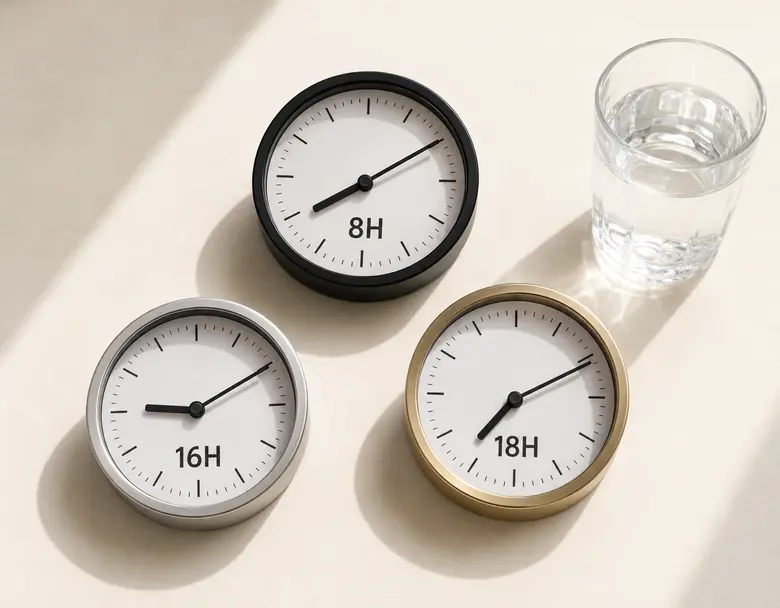
An intermittent fasting eating window is the part of the day when you eat. In a 16:8 schedule, you fast for 16 hours and eat within an 8-hour window. In an 18:6 schedule, you fast for 18 hours and have a 6-hour eating window. A 12:12 or 14:10 schedule gives you more time to eat and may be easier to fit around regular meals.
The best window is not automatically the shortest one. Compare the structure, flexibility, nutrition demands, and likely trade-offs of each schedule, then choose the option that supports balanced meals and a routine you can repeat.[2][3][4] For personalized schedule selection, see how to choose an intermittent fasting schedule.
Key takeaways
- “8-hour intermittent fasting” usually refers to an 8-hour eating window in a 16:8 schedule, not an 8-hour fast.
- 12:12 and 14:10 provide gentler structures than 16:8 or 18:6.
- 16:8 is common, but it is not required for intermittent fasting and is not automatically better than 14:10.
- 18:6 leaves less time for meals, fluids, protein, fiber, and social eating.
- A tighter eating window is only useful if you can eat adequately and do not develop symptoms or rebound eating.
- People with diabetes, medication needs, pregnancy, breastfeeding, low body weight, chronic illness, or eating-disorder risk need individualized guidance.
Table of Contents
- Key takeaways
- What do 8-hour, 16-hour, and 18-hour terms mean?
- How the common eating windows compare
- 12:12: a gentle overnight structure
- 14:10: more structure with a wider eating window
- 16:8: a common eight-hour eating window
- 18:6: a more restrictive six-hour window
- What should you compare before choosing a window?
- How to compare a window without making it stricter
- What can you drink during a fasting window?
- When should you shorten the window or seek guidance?
- FAQ
- Bottom line
- Medical disclaimer
- References
What do 8-hour, 16-hour, and 18-hour terms mean?
Fasting content often uses the same number to describe two different parts of the schedule. Read the number in context:
| Phrase | Usually means | Example |
|---|---|---|
| 8-hour eating window | Eating for 8 hours and fasting for the remaining 16 | Eat from noon to 8 p.m.; fast from 8 p.m. to noon |
| 16-hour fast | Fasting for 16 hours and eating within 8 hours | The fasting part of a 16:8 schedule |
| 18-hour fast | Fasting for 18 hours and eating within 6 hours | Eat from 1 p.m. to 7 p.m.; fast the rest of the day |
The schedule describes timing, not food quality. A shorter eating window still needs balanced meals, enough fluids, and a plan that fits medication and health needs.
How the common eating windows compare
| Schedule | Fasting window | Eating window | Possible advantage | Main trade-off |
|---|---|---|---|---|
| 12:12 | 12 hours | 12 hours | Often easy to fit around breakfast and dinner | Provides lighter structure |
| 14:10 | 14 hours | 10 hours | Adds structure while leaving room for regular meals | May require shifting one meal or snack |
| 16:8 | 16 hours | 8 hours | Clear, popular routine with two or three eating occasions | Meals can become rushed or oversized |
| 18:6 | 18 hours | 6 hours | More concentrated eating schedule | Harder to meet nutrition and social needs |
These are comparisons, not steps that everyone should complete. You can stay with 12:12 or 14:10 if it works better for you.[2][3]
12:12: a gentle overnight structure
With 12:12, you fast for 12 hours and eat within 12 hours. Finishing dinner at 7 p.m. and eating breakfast at 7 a.m. is one example.
This structure may be useful when the main goal is to reduce late-night grazing without intentionally skipping a full meal. It can also provide a low-pressure way to observe hunger, sleep, energy, and meal timing.
12:12 is not “too easy” to count. A schedule that reduces unplanned eating and remains comfortable can be more sustainable than a stricter window that repeatedly fails.
14:10: more structure with a wider eating window
With 14:10, you fast for 14 hours and eat within 10 hours. For example, you might finish dinner at 7 p.m. and have your first meal at 9 a.m.
Compared with 16:8, 14:10 leaves more time for breakfast, lunch, dinner, medication requirements, and social meals. It may be a useful middle option for someone who wants more structure but finds 16:8 too restrictive.
The eating window still needs balanced meals. Extending the fast while cutting food quality or total intake is not an improvement.
16:8: a common eight-hour eating window
With 16:8, you fast for 16 hours and eat within 8 hours. A noon-to-8 p.m. schedule is a common example, although the window can be placed differently.
16:8 may fit adults who already tolerate a 12- or 14-hour overnight fast, can eat balanced meals without rushing, and do not have medical or medication concerns that make skipped meals risky. It may be a poor fit if it causes poor sleep, dizziness, intense food preoccupation, or very large meals.
This page compares the structure only. For a complete 16:8 start guide, see 16:8 intermittent fasting.
18:6: a more restrictive six-hour window
With 18:6, you fast for 18 hours and eat within 6 hours. The shorter eating window can make it harder to fit enough protein, fiber, fluids, and total food, especially for active people or anyone with a demanding schedule.
18:6 should not be treated as the automatic next step after 16:8. If 16:8 already causes symptoms, overeating, poor recovery, or anxiety around food, widening the eating window is usually more appropriate than pushing the fast longer.
What should you compare before choosing a window?
Compare more than the number of fasting hours:
- Meal adequacy: Can you fit enough balanced meals into the eating window?
- Daily routine: Does the window work with work, family, travel, and social meals?
- Sleep: Does it encourage very late meals or make you go to bed hungry?
- Exercise: Can you fuel and recover around training?
- Medication: Do any medicines require food or consistent timing?
- Appetite: Does the window reduce grazing or trigger rebound eating?
- Health context: Are there conditions that make fasting unsuitable or require supervision?
For the separate question of what time of day to place the window, see the best time for intermittent fasting. This page focuses on window length, not a universal breakfast or dinner time.
How to compare a window without making it stricter
Test one realistic window while keeping the rest of the routine reasonably stable. Notice whether you can complete the fast, eat calmly, sleep normally, stay hydrated, and maintain daily responsibilities.
If the window works, repeat it. If it does not, move to a wider eating window. Do not treat one difficult day as proof that you need more discipline, and do not extend the fast to compensate for an unplanned meal.
The right comparison is not “Which schedule is most intense?” It is “Which schedule gives me useful structure with the fewest avoidable trade-offs?”
What can you drink during a fasting window?
For a clean fast, common simple choices include plain water, black coffee, and unsweetened tea. Calorie-containing drinks, milk, cream, juice, alcohol, protein shakes, and calorie-containing add-ins belong in the eating window. For detailed beverage guidance, see what you can drink during intermittent fasting.
During the eating window, focus on balanced meals rather than trying to compensate for the fasting period with very large portions. Fasting hours do not replace adequate nutrition.
When should you shorten the window or seek guidance?
Shorten the fast, return to a wider eating window, or seek professional advice if you experience:
- persistent dizziness, faintness, weakness, or unusual fatigue;
- repeated headaches, nausea, or sleep disruption;
- low-blood-sugar symptoms or concerns about diabetes medication;
- difficulty eating enough protein, fiber, fluids, or total food;
- intense cravings followed by binge-like eating;
- increasing anxiety, guilt, or rigid thoughts around food;
- menstrual, pregnancy, breastfeeding, or fertility concerns.
Longer fasts of 24 hours or more are a different category from daily eating-window comparisons and are not automatically better.[2][4] See fasting warning signs and when to stop if symptoms are severe, persistent, or concerning.
FAQ
What is an intermittent fasting eating window?
It is the period during which you eat in a time-restricted eating schedule. In 16:8, the eating window is 8 hours and the fasting window is 16 hours.
Is an 8-hour eating window the same as 16-hour intermittent fasting?
Usually, yes. A 16:8 schedule means 16 hours of fasting followed by an 8-hour eating window.
Is 16:8 better than 14:10?
Not automatically. 16:8 is more restrictive, while 14:10 leaves more room for meals and daily life. The better option is the one you can repeat while eating adequately and feeling well.
Is 18:6 better than 16:8?
No universal evidence makes 18:6 better for everyone. It provides a shorter eating window and may create more practical and nutrition challenges.
Which eating window is best for beginners?
Many beginners find 12:12 or 14:10 easier to test than 16:8 or 18:6. Starting gently is optional but can make it easier to evaluate how the routine fits.
Can I change my eating window on weekends?
Exact clock times do not have to be identical every day. Keep the routine flexible enough for real life, but avoid repeatedly changing it in ways that cause missed meals or overeating.
Can I exercise with a shorter eating window?
Some people can, but the window must still allow adequate food, fluids, and recovery. If training quality or recovery declines, widen the window and consider individualized guidance.
Does a shorter eating window guarantee faster weight loss?
No. A shorter window may reduce eating opportunities for some people, but weight change depends on overall intake, food quality, activity, sleep, and consistency. Fasting is not automatically superior to other sustainable approaches [1].
Bottom line
12:12 and 14:10 offer wider eating windows, 16:8 is a common middle option, and 18:6 is more restrictive. None is automatically the best. Compare each window by nutrition, schedule, sleep, exercise, medication, appetite, and safety, then choose the one you can repeat without forcing your body or your life to fit the clock.
Medical disclaimer
This article is for general education only and is not medical advice. Speak with a qualified healthcare professional before fasting if you have diabetes, take medication, are pregnant or breastfeeding, are underweight, have a chronic condition, have a history of an eating disorder, or experience concerning symptoms.
References
- Cochrane. Intermittent fasting, traditional dietary advice or no treatment: which works better to help adults living with overweight or obesity lose weight? https://www.cochrane.org/evidence/CD015610_intermittent-fasting-traditional-dietary-advice-or-no-treatment-which-works-better-help-adults
- Johns Hopkins Medicine. Intermittent Fasting: What Is It, And How Does It Work? https://www.hopkinsmedicine.org/health/wellness-and-prevention/intermittent-fasting-what-is-it-and-how-does-it-work
- Cleveland Clinic. Intermittent Fasting: What It Is, Benefits and Schedules https://health.clevelandclinic.org/intermittent-fasting-4-different-types-explained
- Mayo Clinic. Intermittent fasting: What are the benefits? https://www.mayoclinic.org/healthy-lifestyle/nutrition-and-healthy-eating/expert-answers/intermittent-fasting/faq-20441303