



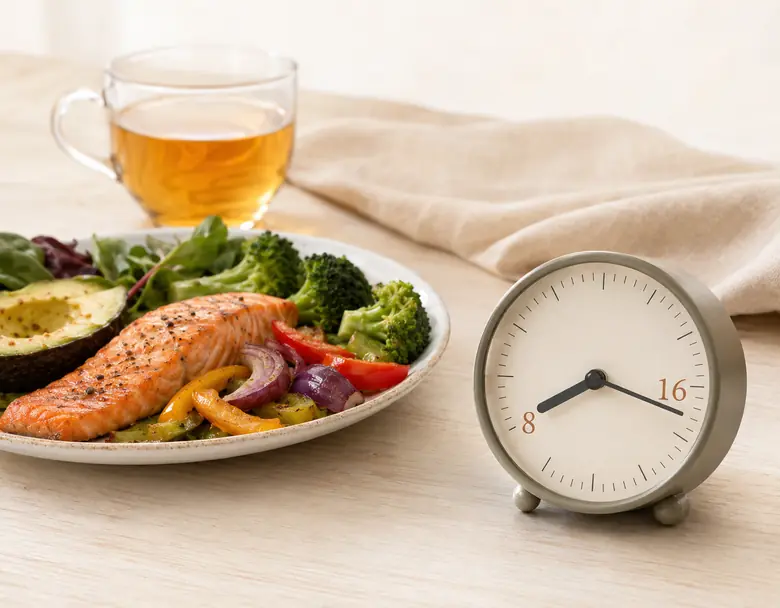
16:8 intermittent fasting means going 16 hours without calorie-containing food or drinks and eating within an 8-hour window each day. A common example is eating from 12 p.m. to 8 p.m. and fasting from 8 p.m. until 12 p.m. the next day.
16:8 is a popular time-restricted eating schedule, but it is not automatically better than a gentler pattern and it is not suitable for everyone.[1][2][4] If you are new to fasting, starting with 12:12 or 14:10 may be easier. People with diabetes, medication needs, pregnancy or breastfeeding, low body weight, eating-disorder risk, or other medical conditions should get qualified guidance before attempting 16:8.[3][6]
Key takeaways
- 16:8 means 16 hours of fasting followed by an 8-hour eating window.
- The clock time can vary; choose an 8-hour window that fits your sleep, work, meals, exercise, and medication needs.
- 16:8 does not require one particular food plan, but balanced meals and calorie-free fasting-window drinks support a more sustainable routine.
- A longer fast is not automatically more effective. Step back to 14:10 or 12:12 if 16:8 causes persistent hunger, low energy, overeating, or other problems.
- Fasting should not be self-guided when it may affect blood sugar, medication timing, pregnancy, breastfeeding, or eating-disorder recovery.
Table of Contents
- Key takeaways
- What does 16:8 intermittent fasting mean?
- 16:8 schedule examples
- How to start 16:8 gradually
- What should you eat during the 8-hour window?
- Common 16:8 mistakes
- Who may fit 16:8?
- When 16:8 may be too restrictive
- Who should not start 16:8 without medical guidance?
- Can you exercise while following 16:8?
- FAQ
- Bottom line
- Medical disclaimer
- References
What does 16:8 intermittent fasting mean?
16:8 is a daily eating pattern with two parts:
| Part of the schedule | Meaning |
|---|---|
| 16-hour fasting window | No calorie-containing food or drinks |
| 8-hour eating window | Meals and snacks are planned within this period |
| Daily repetition | The pattern is used on most days, depending on the person and plan |
The eating window does not mean eating continuously or compensating for the fast with very large meals. Food quality, total intake, hydration, sleep, activity, and consistency still affect how the routine feels and what outcomes are possible.[5][7][8]
16:8 is one option among several intermittent fasting patterns. For a direct comparison with 12:12, 14:10, and 18:6, read Intermittent Fasting Eating Windows: 8, 16, and 18 Hours.
16:8 schedule examples
There is no single required clock time. Choose the window that lets you eat balanced meals without regularly eating at a time that disrupts sleep, work, exercise, or family life.
| Eating window | Fasting window | May suit |
|---|---|---|
| 8 a.m. to 4 p.m. | 4 p.m. to 8 a.m. | People who prefer breakfast and an early dinner |
| 10 a.m. to 6 p.m. | 6 p.m. to 10 a.m. | People who want lunch and an earlier evening meal |
| 11 a.m. to 7 p.m. | 7 p.m. to 11 a.m. | A common workday routine |
| 12 p.m. to 8 p.m. | 8 p.m. to 12 p.m. | People who prefer a later first meal or shared dinner |
The fasting duration is what defines 16:8. A small change in start time for work, travel, or social plans does not automatically invalidate the routine. For a broader discussion of daily timing, see What Is the Best Time to Eat With Intermittent Fasting?.
How to start 16:8 gradually
You do not need to begin with a full 16-hour fast. A gradual progression can make it easier to notice how your energy, hunger, sleep, digestion, and mood respond.
- Track your usual first and last calorie-containing meal for several days.
- Try a 12:12 pattern, such as eating from 7 a.m. to 7 p.m.
- Move to 14:10, such as eating from 9 a.m. to 7 p.m., if 12:12 feels manageable.
- Choose an 8-hour window that allows enough time for two balanced meals, or two meals and a suitable snack.
- Test the routine for about one to two weeks before making it stricter.
- Shorten or pause the fast if symptoms, eating patterns, sleep, exercise, or daily function worsen.
If you want help choosing among different fasting patterns, use How to Choose an Intermittent Fasting Schedule. This page focuses on how 16:8 works and how to test it safely.
A simple 7-day progression
Use the first week to test whether 16:8 fits your routine rather than treating it as a pass-or-fail challenge.
| Days | Suggested pattern | Focus |
|---|---|---|
| 1–2 | 12:12 or 14:10 | Keep meals normal and observe hunger, sleep, mood, and digestion |
| 3–4 | 14:10 or 15:9 | Narrow the window only if the first step feels stable |
| 5–7 | 16:8 | Try the full schedule only if you can still eat balanced meals and feel steady |
If 16:8 causes evening overeating, move the eating window earlier or return to a wider window. If mornings feel weak, distracted, or unsafe, do not force the progression.
Missing or shortening one fasting window is not a reason to compensate with a longer fast. Return to the next meal pattern that feels safe and review whether the problem was timing, meal adequacy, sleep, activity, or an overly narrow window. A routine that allows occasional adjustments is more realistic than one that turns a single late meal into an all-or-nothing cycle.
What should you eat during the 8-hour window?
16:8 does not prescribe one fixed menu. Aim for meals that provide enough nutrition to support the next fasting period instead of relying on highly processed foods or one very large meal.
A simple meal structure can include:
- Protein foods such as eggs, fish, poultry, tofu, beans, yogurt, or other suitable options
- Vegetables and fruit for fiber and micronutrients
- Whole grains, potatoes, beans, or other carbohydrate sources as appropriate for your needs and activity
- Nuts, seeds, olive oil, avocado, or other sources of unsaturated fat
- Water with meals and throughout the day
For a more detailed discussion of fasting-window drinks, see What Can You Drink During Intermittent Fasting?. During the fasting window, water is the simplest choice. Unsweetened tea or black coffee may fit some people, while sugar, milk, cream, juice, alcohol, and other calorie-containing additions belong in the eating window.
Common 16:8 mistakes
Starting too aggressively
Moving directly from frequent eating to a 16-hour fast can make it harder to identify what is causing hunger, fatigue, or irritability. A shorter overnight fast provides a more manageable starting point.
Eating too little during the window
Skipping breakfast, eating a very small first meal, and then arriving at dinner extremely hungry can make the schedule difficult to sustain. Use the eating window to plan adequate meals rather than trying to minimize food as much as possible.
Treating the eating window as unrestricted
16:8 does not cancel the effect of total intake or food quality. Large portions, sugary drinks, alcohol, or frequent snacks can work against a person’s goals even when they fit inside eight hours.[5][7][8]
Chasing longer fasts
Moving from 16:8 to 18:6, 20:4, or longer fasts is not required. Longer fasts are not automatically more effective and may increase risk for some people.
Ignoring warning signs
Fainting, severe weakness, binge eating, intense anxiety around food, worsening sleep, or other unsafe symptoms are reasons to pause and reassess—not signs that you need more discipline.
Who may fit 16:8?
16:8 may be reasonable for an adult who already tolerates a shorter overnight fast, can eat balanced meals within eight hours, and does not have a medical or medication issue that makes fasting unsafe.
It may be a workable option if you can:
- Maintain adequate food and fluid intake during the eating window
- Avoid rebound overeating when the window opens
- Keep the schedule compatible with sleep, work, family meals, and exercise
- Adjust to a wider window if 16 hours becomes difficult
The goal is not to prove that you can tolerate the longest fast possible. If 14:10 supports better meals, energy, and consistency, it may be a better routine for you than 16:8.
When 16:8 may be too restrictive
16:8 may be too demanding if it causes any of the following:
| Sign | Safer next step |
|---|---|
| Persistent dizziness, weakness, nausea, or unusual fatigue | Stop or shorten the fast and assess the cause |
| Bingeing or feeling out of control when the window opens | Pause 16:8 and seek appropriate support |
| Inability to fit enough balanced food into eight hours | Widen the eating window |
| Poor sleep, worsening mood, or reduced exercise tolerance | Reassess timing, intake, and fasting length |
| Conflict with medication or blood-glucose management | Get medical guidance before continuing |
Possible side effects reported with intermittent fasting include hunger, headaches, tiredness, dizziness, constipation, mood changes, and menstrual changes.[8] Persistent or severe symptoms are a reason to stop and seek advice rather than push through.[3]
Who should not start 16:8 without medical guidance?
Talk with a qualified healthcare professional before starting or changing a 16:8 routine if you:
- Have diabetes or take insulin or other medicine that can lower blood glucose
- Take medication that must be taken with food or at a specific time
- Are pregnant or breastfeeding
- Are underweight, have nutritional deficiencies, or are recovering from illness or surgery
- Have a current or previous eating disorder, or feel that fasting is increasing anxiety around food
- Are a child or teenager
Fasting can change meal timing, carbohydrate intake, hydration, and blood-glucose patterns. Do not change a prescription schedule to make 16:8 easier. For related guidance, read Can You Take Medication While Intermittent Fasting?.
Can you exercise while following 16:8?
Many people can continue familiar, moderate exercise, but the best timing depends on the person, activity, hydration, and food intake. Some prefer training near the eating window so a meal can follow; others feel comfortable exercising during the fast.
Do not treat fasted exercise as a requirement. Stop or change the plan if exercise causes dizziness, weakness, nausea, faintness, or an unusual drop in performance. See Intermittent Fasting and Exercise: How to Pair Them Without Overdoing It for more detail.
FAQ
What is the 16:8 intermittent fasting schedule?
It is a daily pattern with 16 hours without calorie-containing food or drinks and an 8-hour eating window. For example, you might eat from 11 a.m. to 7 p.m. and fast from 7 p.m. to 11 a.m. the next day.
Is 16:8 good for beginners?
It can be manageable for some adults, but it is not required as a first step. Starting with 12:12 or 14:10 may make it easier to learn the routine and identify symptoms before attempting a longer fast.
What time should I start and end my 16:8 fast?
Choose an 8-hour eating window that fits your sleep, work, exercise, family meals, and health needs. Examples include 8 a.m. to 4 p.m., 10 a.m. to 6 p.m., 11 a.m. to 7 p.m., and 12 p.m. to 8 p.m. No single option is best for everyone.
Do 16:8 fasting times have to be exactly the same every day?
Not necessarily. A broadly consistent routine may make hunger and planning easier, but modest changes for work, travel, or social events are normal. Avoid using flexibility as a reason to extend the fast until you feel unwell.
Can I drink coffee during a 16-hour fast?
Black coffee is a common calorie-free option. Sugar, milk, cream, flavored syrups, and other calorie-containing additions belong in the eating window. Caffeine can affect people differently, so reduce it if it worsens anxiety, sleep, reflux, or other symptoms.
Does 16:8 cause weight loss?
It may help some people reduce eating opportunities or total intake, but weight loss is not automatic. Food quality, portion size, sleep, activity, health status, and long-term adherence also matter. Eating large amounts of high-calorie food during the 8-hour window can offset the intended change.
Is 16:8 better than 14:10?
Not automatically. 16:8 is more restrictive. If 14:10 is easier to repeat and supports adequate, balanced meals, it may be the more appropriate option for you.
When should I stop 16:8 fasting?
Stop or shorten the fast if you develop persistent or severe symptoms, cannot eat adequately, begin bingeing, or find that the routine is worsening sleep, mood, exercise, or your relationship with food. Seek prompt medical help for fainting, confusion, chest pain, repeated vomiting, severe dehydration, or symptoms of low blood sugar. For additional warning signs, read Fasting Warning Signs: When to Stop and Get Help.
Bottom line
16:8 is a 16-hour fasting period followed by an 8-hour eating window. It can be a clear and practical routine for some adults, but it is not a required milestone or a guarantee of weight loss. Start with a gentler pattern if needed, choose a realistic clock time, eat balanced meals, and step back whenever the routine conflicts with health, medication, nutrition, or daily function.
Medical disclaimer
This article provides general educational information and is not medical advice. Consult a qualified healthcare professional before starting or changing 16:8 fasting if you have diabetes, take medication, are pregnant or breastfeeding, are underweight, have a history of an eating disorder, are recovering from illness or surgery, or are under 18. Do not change prescription timing without professional advice. Stop fasting and seek appropriate medical help if you experience fainting, confusion, chest pain, repeated vomiting, severe dehydration, or symptoms of low blood sugar.
References
- Johns Hopkins Medicine. Intermittent Fasting: What Is It, And How Does It Work? https://www.hopkinsmedicine.org/health/expert-qa/intermittent-fasting-what-is-it-and-how-does-it-work
- Cleveland Clinic. Intermittent Fasting: What It Is, Benefits and Schedules https://health.clevelandclinic.org/intermittent-fasting-4-different-types-explained
- Cleveland Clinic. 6 Tips for Fasting Safely https://health.clevelandclinic.org/tips-for-fasting-the-healthy-way
- Mayo Clinic. Intermittent fasting: What are the benefits? https://www.mayoclinic.org/healthy-lifestyle/nutrition-and-healthy-eating/expert-answers/intermittent-fasting/faq-20441303
- Harvard Health Publishing. Should you try intermittent fasting for weight loss? https://www.health.harvard.edu/blog/should-you-try-intermittent-fasting-for-weight-loss-202207282790
- Centers for Disease Control and Prevention. Manage Blood Sugar https://www.cdc.gov/diabetes/treatment/index.html
- Harvard T.H. Chan School of Public Health. Diet Review: Intermittent Fasting for Weight Loss https://nutritionsource.hsph.harvard.edu/healthy-weight/diet-reviews/intermittent-fasting/
- Cochrane. Intermittent fasting for adults with overweight or obesity https://www.cochrane.org/evidence/CD015610_intermittent-fasting-traditional-dietary-advice-or-no-treatment-which-works-better-help-adults