



Choosing an intermittent fasting plan means choosing a repeatable eating schedule, not chasing the longest possible fast. A useful plan should fit your goal, daily routine, experience level, food needs, sleep, exercise, social life, and health context.
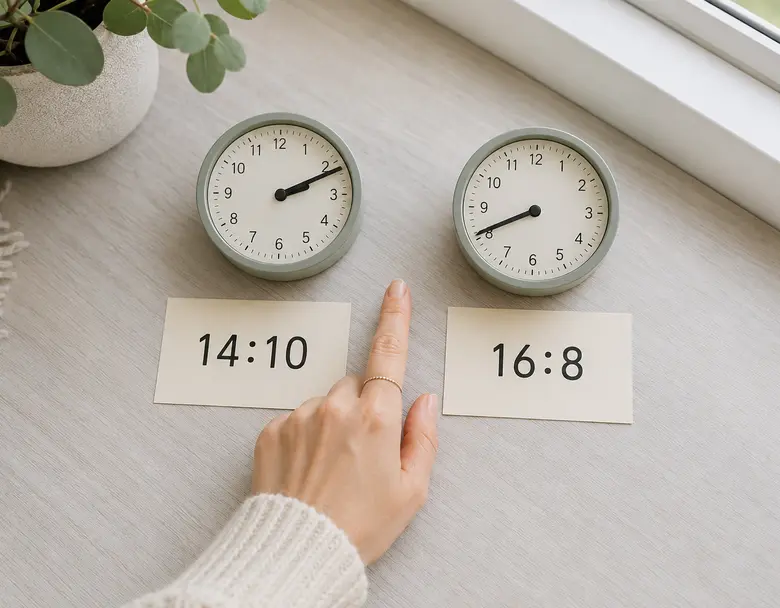
Some people do best with a gentle 12:12 or 14:10 schedule. Others prefer a 16:8 routine because it creates more structure without requiring a full-day fast. More advanced plans, such as 20:4, OMAD, 5:2, 4:3, or 24-hour fasting, can feel much more restrictive and are not appropriate for everyone.
This guide helps you compare the main intermittent fasting plans, choose a realistic starting point, build a weekly schedule, and recognize when a plan may be too intense.
Table of Contents
How to Choose an Intermittent Fasting Plan
The best intermittent fasting plan is usually the one you can follow consistently while still eating enough, sleeping well, staying active, and feeling functional during the day. A plan that looks effective on paper may not work if it creates headaches, overeating, poor concentration, low mood, social stress, or a cycle of restriction and rebound eating.
Start by asking four questions:
- What is the main reason I want a fasting plan?
- What schedule could I repeat on normal weekdays?
- How much fasting experience do I already have?
- Are there health, medication, life stage, or eating-history reasons to avoid fasting or use extra caution?
For a step-by-step selection process, use How to Choose the Best Intermittent Fasting Plan for You. If you are comparing plans by lifestyle fit, Which Intermittent Fasting Plan Is Best for Me? can help you narrow the choice. For a simpler decision prompt, see How to choose your plan?.
Start with your goal
Different fasting plans solve different problems. If your goal is to reduce late-night snacking, a simple overnight fast may be enough. If your goal is meal structure, a daily eating window such as 14:10 or 16:8 may be easier to repeat than alternate-day style plans. If weight management is part of your goal, remember that fasting does not make food quality or overall intake irrelevant. What and how much you eat during the eating window still matter.[2]
Avoid choosing a plan only because it sounds more extreme. A longer fast is not automatically better. The plan should create a structure you can live with, not a rule that pushes you into fatigue, irritability, or compensatory overeating.
Match the plan to your daily schedule
A fasting plan should match the shape of your day. Consider:
- When you wake up and go to sleep
- When you work, study, commute, or care for others
- When you exercise
- Whether family meals matter to you
- Whether weekends are very different from weekdays
- Whether skipping breakfast, delaying lunch, or stopping evening snacks feels most realistic
For many people, the easiest plan is the one that changes the fewest things. For example, if you already eat dinner early and rarely snack at night, a 12:12 or 14:10 plan may feel natural. If you prefer a later first meal and can still eat enough during the day, 16:8 may fit better.
Consider experience and sustainability
If you are new to intermittent fasting, start with a plan that feels almost too manageable. That may mean 12:12 for one or two weeks, then 14:10, and only later 16:8 if your body and schedule adapt well.
A sustainable plan should allow you to:
- Eat balanced meals during the eating window
- Drink enough fluids
- Maintain normal work or school performance
- Sleep normally
- Exercise safely
- Avoid feeling preoccupied with food all day
- Adjust for travel, social events, or illness
If a plan only works when life is perfectly controlled, it may not be the right default plan.
Identify health and lifestyle limitations
Some situations require caution or medical guidance. People who are pregnant or breastfeeding, people with diabetes, people taking glucose-lowering medication, people with a history of eating disorders, and people with medical conditions affected by food timing should not treat fasting plans as a casual experiment.[1]
You should also scale back if fasting makes you dizzy, faint, unusually weak, unable to focus, unable to sleep, or likely to binge after the fast. A fasting plan is a tool, not a test of willpower.
How Do the Main Fasting Plans Compare?
Intermittent fasting plans differ by fasting length, eating-window length, flexibility, and intensity. The plan names can look simple, but the real difference is how much they affect your meals, energy, social routine, and ability to meet nutrient needs.
| Plan type | Typical structure | Best suited for | Difficulty |
|---|---|---|---|
| 12:12 | 12-hour fast, 12-hour eating window | Beginners, routine-building, evening snack reduction | Low |
| 14:10 | 14-hour fast, 10-hour eating window | Beginners moving toward a longer fast | Low to moderate |
| 16:8 | 16-hour fast, 8-hour eating window | People who want a clear daily structure | Moderate |
| 18:6 | 18-hour fast, 6-hour eating window | More experienced fasters | Moderate to high |
| 20:4 | 20-hour fast, 4-hour eating window | Advanced users with strong planning skills | High |
| OMAD | One meal a day | Advanced users; not suitable for many people | High |
| 5:2 | 5 regular days, 2 lower-intake days | People who prefer weekly variation | Moderate to high |
| 4:3 | 4 regular days, 3 lower-intake days | Experienced users; more restrictive | High |
| 24-hour fast | One full-day fast or dinner-to-dinner fast | Advanced users with medical caution | High |
Use comparisons as a starting point, not as a ranking. The “best” plan is not the most restrictive plan. It is the plan that matches your goal, supports adequate nutrition, and can be adjusted when your schedule or body tells you to scale back.
For a direct comparison of two common beginner-to-intermediate plans, see 14/10 vs 16/8 Intermittent Fasting.
Gentle plans for beginners
Gentle plans shorten the eating day without requiring a dramatic change. A 12:12 plan may simply mean finishing dinner at 7 p.m. and eating breakfast at 7 a.m. A 14:10 plan might mean delaying breakfast or closing the kitchen earlier in the evening.
These plans are useful because they help you practice consistency, hydration, meal timing, and hunger awareness without forcing a long fast immediately.
Standard time-restricted eating plans
A 16:8 schedule is one of the most common time-restricted eating patterns. It creates a clear fasting window and an eight-hour eating window, which some people find easier to follow than daily calorie counting. However, the schedule still needs to leave enough room for satisfying meals.
If your eight-hour window becomes rushed, under-fueled, or overly restrictive, you may need a wider eating window or a slower transition.
Advanced and higher-intensity plans
Plans such as 18:6, 20:4, OMAD, 5:2, 4:3, and 24-hour fasting place more pressure on meal planning, appetite management, and safety. They may also be harder to combine with intense exercise, shift work, social meals, or high nutrient needs.
Do not move into an advanced plan simply because a shorter plan stopped feeling exciting. If a moderate plan is working well, staying there can be a smart choice.
Comparison by fasting length, flexibility, and difficulty
When comparing plans, look beyond the number of fasting hours. Ask:
- Can I eat enough protein, fiber, fruits, vegetables, and other nutrient-dense foods in the eating window?
- Does the plan fit my work and family schedule?
- Can I exercise without feeling depleted?
- Can I sleep normally?
- Can I make room for social meals without feeling like I failed?
- Can I repeat this for weeks without becoming overly rigid?
If the answer is no, the plan may be too narrow or too intense.
Beginner Fasting Plans
Beginner fasting plans should make the first step easier, not harder. The goal is to build a pattern you can repeat while learning how your body responds.
A good beginner sequence might look like this:
- Start with 12:12.
- Try 14:10 if 12:12 feels comfortable.
- Move toward 16:8 only if meals, energy, sleep, and mood remain stable.
- Stay at the current level if longer fasting creates problems.
For beginner-specific guidance, start with 12/12 Intermittent Fasting Guide, 14/10 Intermittent Fasting Guide, Beginner Intermittent Fasting Schedule, and Free Intermittent Fasting Plan: A Simple Starter Template.
12:12 as a gentle starting point
A 12:12 plan divides the day into a 12-hour fasting window and a 12-hour eating window. It is often the easiest place to start because much of the fasting window happens overnight.
This plan can help you practice:
- Setting a consistent dinner cutoff
- Reducing late-night grazing
- Planning breakfast instead of eating randomly
- Noticing true hunger versus habit-based snacking
A 12:12 plan may also be enough for someone who mainly wants structure rather than a more restrictive fasting routine.
Moving toward 14:10 or 16:8
If 12:12 feels easy and your meals are still balanced, you may choose to try 14:10. This usually means fasting for 14 hours and eating within a 10-hour window.
A 16:8 plan is a bigger step. It can work well for people who prefer two main meals plus a snack or who naturally do not want an early breakfast. But if 16:8 makes you feel rushed during the eating window or leads to overeating at night, 14:10 may be a better fit.
When to stay at the current level
Progress does not always mean making the fast longer. Stay with your current plan if:
- You are still learning how to eat enough during the window
- Hunger feels manageable but not yet easy
- Sleep or energy is changing
- Exercise feels harder than usual
- You are becoming too focused on the clock
- Social meals are becoming stressful
A stable 14:10 plan is usually better than an unstable 18:6 plan.
Popular Intermittent Fasting Plans
Once you understand the basic structure, you can compare specific plans more clearly. Each plan has a different balance of simplicity, flexibility, and intensity.
16:8 intermittent fasting
The 16:8 plan uses a 16-hour fasting window and an eight-hour eating window. Common examples include eating from 10 a.m. to 6 p.m., 11 a.m. to 7 p.m., or noon to 8 p.m.
This plan is popular because it is structured but still allows multiple eating occasions. It may be easier than more restrictive plans because you can usually fit two meals and possibly a snack into the window.
For more detail, see 16/8 Intermittent Fasting Guide, 16/8 Intermittent Fasting Diet Plan, 16/8 Intermittent Fasting Schedule, 16/8 Intermittent Fasting Benefits, and 16/8 Intermittent Fasting Results: What to Expect.
18:6 intermittent fasting
The 18:6 plan narrows the eating window to six hours. This may appeal to people who already feel comfortable with 16:8 and want a slightly shorter eating period.
Some people prefer an intermediate step before 18:6, such as a 15:9 schedule. That kind of gradual progression can make the routine easier to test before narrowing the eating window further.
Because the window is smaller, meal planning matters more. You may need to be more intentional about protein, fiber, fluids, and meal timing so the window does not become too rushed.
For dedicated guides, see 15/9 Intermittent Fasting Guide and 18/6 Intermittent Fasting Guide.
20:4 intermittent fasting
The 20:4 plan creates a 20-hour fasting window and a four-hour eating window. This is a high-intensity schedule and is not a beginner plan.
A four-hour eating window can make it difficult for some people to eat enough, get enough nutrients, or avoid feeling overly restricted. It may also be harder to combine with demanding workouts or unpredictable workdays.
For more detail, see 20/4 Intermittent Fasting Guide and 20/4 Intermittent Fasting Results.
OMAD and one-meal-a-day fasting
OMAD usually means eating one meal per day. It is one of the most restrictive intermittent fasting patterns and can be difficult to do safely or sustainably.
Because one meal has to carry the full day’s nutrition, OMAD may increase the risk of under-eating, overeating, digestive discomfort, or food preoccupation for some people. It is not appropriate for many health contexts and should be approached with caution.
For more context, see OMAD Intermittent Fasting Guide.
5:2, 4:3, and 24-hour fasting
The 5:2 plan usually involves five regular eating days and two lower-intake days. The 4:3 plan increases the number of lower-intake days. A 24-hour fast usually means fasting from one meal to the same meal the next day, such as dinner to dinner.
These plans are different from daily time-restricted eating because they change the rhythm of the week. Some people like that flexibility; others find the low-intake or long-fasting days harder to manage.
For plan-specific guidance, see 5:2 Intermittent Fasting Guide, 5:2 Intermittent Fasting Diet Plan, 4:3 Intermittent Fasting Guide, and 24-Hour Intermittent Fasting Guide.
Goal or health-context comparisons
If you are choosing among several plans, compare them by your goal and context rather than by popularity. A plan for reducing late-night snacking may look different from a plan for simplifying meal timing or supporting weight management.
For a broader comparison by goal, see Best Intermittent Fasting Plan by Goal or Health Context.
How to Build and Adjust a Fasting Schedule
After choosing a plan, turn it into a practical schedule. The schedule should define when the fast starts, when the eating window opens, when the eating window closes, and how you will handle exceptions.
A useful schedule answers questions like:
- What time do I finish dinner?
- What time do I have my first meal?
- What happens if I exercise in the morning?
- What happens if dinner is later than usual?
- Do weekends follow the same plan?
- How do I switch fasting times without making the plan chaotic?
For practical schedule support, use How Many Hours Should You Intermittent Fast?, 16/8 Intermittent Fasting Schedule, Do fasting times have to be fixed every day, and How do I switch my fasting time.
Choosing a fasting start and end time
Most fasting schedules are easier to maintain when the fasting window starts after dinner and continues overnight. This keeps a large part of the fast during sleep.
For example:
- 12:12: eat from 7 a.m. to 7 p.m.
- 14:10: eat from 9 a.m. to 7 p.m.
- 16:8: eat from 11 a.m. to 7 p.m.
- 16:8 later window: eat from noon to 8 p.m.
The right window depends on your life. If family dinner is important, do not choose a window that forces you to skip it every day. If morning workouts leave you depleted, you may need an earlier eating window.
Whether fasting times need to be fixed every day
Fasting times do not have to be identical every day for everyone. Some people like a fixed routine because it reduces decisions. Others need a flexible pattern because work, caregiving, travel, or social meals change from day to day.
The key is to avoid turning flexibility into randomness. If your fasting times shift, keep a basic rule, such as “most days I use a 14-hour overnight fast” or “on weekdays I use 16:8, and on weekends I use 12:12 or 14:10.”
Switching fasting times
Switching fasting times is usually easier when you move gradually. If you want to shift your eating window earlier or later, adjust by 30 to 60 minutes at a time instead of jumping several hours overnight.
You may also need to adjust meal composition. A later first meal may require a more satisfying dinner the night before. An earlier dinner cutoff may require a better-planned afternoon meal or snack.
Managing weekdays, weekends, and social events
A fasting plan should leave room for real life. Weddings, birthdays, holidays, travel, and family meals are normal. If your plan cannot handle occasional variation, it may become too rigid.
A practical approach is to keep your default plan most days and use a gentler version when needed. For example, someone who follows 16:8 during the week might use 14:10 or 12:12 on a social weekend, then return to the usual schedule without trying to “make up” for it.
Plan Safety and When to Scale Back
A fasting plan should support your life, not disrupt it. More fasting is not better if it causes warning signs or makes it harder to eat enough during the eating window.
Scale back, shorten the fast, or stop fasting if you experience dizziness, faintness, unusual weakness, persistent headaches, trouble sleeping, intense irritability, difficulty concentrating, repeated overeating after fasting, or anxiety around food rules. Seek medical help right away for severe symptoms.
Signs that the plan is too intense
Your plan may be too intense if:
- You regularly feel unwell during the fast
- You cannot eat enough during the eating window
- You feel driven to compensate after breaking the fast
- Your workouts feel unsafe or unusually difficult
- Your sleep worsens
- Your mood or concentration declines
- You feel guilty or anxious when the schedule changes
In these cases, return to a wider eating window, take a break from fasting, or speak with a qualified healthcare professional.
Long fasts, OMAD, and higher-risk situations
Longer fasts and very narrow eating windows require more caution. OMAD, 20:4, 4:3, and 24-hour fasting can be too restrictive for many people, especially if they have high energy needs, intense training, medical conditions, medication schedules, a history of disordered eating, or limited flexibility around meals.
If you are unsure, choose the less intense plan. A moderate plan you can repeat safely is more useful than an advanced plan that creates instability.
How plan selection connects to the general safety guide
Plan safety is not separate from overall fasting safety. The right plan depends on your health context, not just your preference. People with diabetes or people using medications that affect blood sugar should not change meal timing without medical guidance, because fasting can change food intake patterns and may affect blood glucose management.[3]
If you are fasting for weight management, avoid “quick fix” thinking. Safe, long-term weight management usually depends on sustainable eating patterns, physical activity, realistic goals, and ongoing behavior changes rather than extreme short-term restriction.[4]
Frequently Asked Questions
What is the best intermittent fasting plan for beginners?
For many beginners, 12:12 or 14:10 is a better starting point than 16:8. These plans help you practice routine and reduce late-night eating without making the eating window too narrow. If those feel comfortable, you can consider 16:8 later.
Is 16:8 better than 14:10?
Not always. A 16:8 plan is more restrictive because the eating window is shorter. It may work well for some people, but 14:10 may be more sustainable if you need more time for meals, exercise recovery, family meals, or energy stability. See 14/10 vs 16/8 Intermittent Fasting for a direct comparison.
How many hours should I fast?
The right fasting length depends on your goal, experience, schedule, and health context. Beginners may start with 12 hours overnight. More experienced fasters may use 14, 16, or 18 hours, but longer is not automatically better. For a detailed decision guide, see How Many Hours Should You Intermittent Fast?.
Can I change my fasting window from day to day?
Yes, many people can adjust their fasting window when needed. The schedule does not have to be identical every day, but it should still have a clear pattern. For example, you might use 16:8 on weekdays and a more flexible 12:12 or 14:10 schedule on weekends.
Is OMAD safe?
OMAD is highly restrictive and is not appropriate for many people. It can make it harder to eat enough and may increase the risk of feeling overly restricted or preoccupied with food. If you have a medical condition, take medication, are pregnant or breastfeeding, are under 18, have high energy needs, or have a history of an eating disorder, do not start OMAD without qualified medical guidance.
What should I do if a plan feels too hard?
Make the plan easier. Shorten the fasting window, widen the eating window, add a planned meal or snack, or take a break. A fasting plan should be adjustable. Difficulty is feedback, not failure.
Final Takeaway
The best fasting plan is not the longest or strictest one. It is the plan that fits your goal, schedule, experience, health needs, and real life.
Start gently, compare plans honestly, build a schedule you can repeat, and adjust when your body or lifestyle requires it. If a plan makes you feel unwell, overly restricted, or unable to eat enough, scale back. Intermittent fasting should be a flexible structure for eating, not a rule that overrides safety, nutrition, or quality of life.
Medical disclaimer
Intermittent fasting is not appropriate for everyone. If you are pregnant or breastfeeding, have diabetes, take medication that may be affected by changes in food intake, have a history of an eating disorder, are under 18, or have another medical condition, speak with a qualified healthcare professional before starting or changing a fasting plan.[1]
References
- Harvard T.H. Chan School of Public Health. “Diet Review: Intermittent Fasting for Weight Loss.” https://nutritionsource.hsph.harvard.edu/healthy-weight/diet-reviews/intermittent-fasting/
- NIH MedlinePlus Magazine. “5 questions about intermittent fasting.” https://magazine.medlineplus.gov/article/5-questions-about-intermittent-fasting
- National Institute of Diabetes and Digestive and Kidney Diseases. “Diabetes Diet, Eating, & Physical Activity.” https://www.niddk.nih.gov/health-information/diabetes/overview/diet-eating-physical-activity
- National Institute of Diabetes and Digestive and Kidney Diseases. “Choosing a Safe & Successful Weight-loss Program.” https://www.niddk.nih.gov/health-information/weight-management/choosing-a-safe-successful-weight-loss-program